
Medically Reviewed by: Dr. Vijay Kumar Sohanlal, MBBS, MS (Orthopaedics), Orthopaedic & Joint Replacement Surgeon, Founder & Owner, MAHI Multispeciality Hospitals, Kilpauk, Chennai.
Last medically reviewed: September 2026
Knee pain can make you wonder whether something inside the joint is beginning to wear out. Sometimes, the problem involves knee cartilage damage, the wear or injury to the cartilage that helps the joint move smoothly. But hearing “cartilage damage” does not automatically mean that the knee is severely damaged or that replacement surgery is inevitable.
Knee cartilage damage can range from a small, localized injury to widespread cartilage loss associated with osteoarthritis. Understanding which situation applies to you is what makes the difference between simply reacting to a scan and making an informed treatment decision.
The important questions are not only how much cartilage is damaged, but why it happened, how the knee is functioning and how much it is affecting your everyday life.
When knee pain starts feeling different, cartilage may be part of the reason
Articular cartilage is the smooth tissue covering the ends of the bones inside the knee. It helps the joint move with less friction and distributes forces during activities such as walking, climbing stairs and bending the knee.
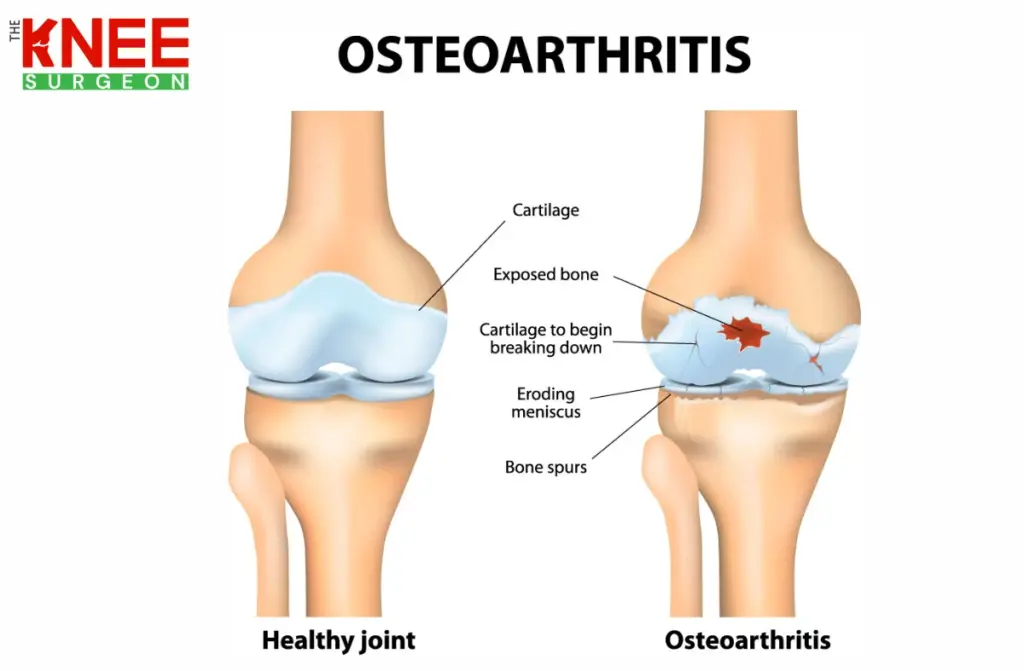
When this cartilage becomes damaged or progressively wears away, the knee may become painful, stiff or swollen. Movement can also become less comfortable as the joint loses some of its normal smoothness.
But cartilage damage is not one single condition. A small cartilage defect in an otherwise healthy knee is very different from extensive cartilage loss affecting an arthritic knee. That distinction becomes important when deciding what treatment, if any, is appropriate.
The pattern of damage matters more than the label
Cartilage can become damaged for several different reasons, and identifying the underlying problem helps shape treatment.
- Previous injury: A sports injury, fracture or damage to structures such as the meniscus or ligaments can alter the mechanics of the knee and contribute to cartilage problems.
- Osteoarthritis: Cartilage may gradually deteriorate as part of degenerative joint disease, eventually affecting the way the knee moves and bears weight.
- Focal cartilage injury: Damage may be limited to one particular area while much of the surrounding joint remains relatively healthy. This can create different treatment possibilities from widespread arthritis.
- Abnormal joint mechanics: Alignment or instability can place greater stress on certain parts of the knee, potentially contributing to progressive cartilage damage.
Clinical Pearl
“Cartilage damage” tells you that a problem exists, but not how serious it is. Its location, depth, size and relationship to the rest of the knee are what help determine its clinical significance.
Your symptoms can show how the knee is coping
Cartilage damage does not feel exactly the same in every person. Some people notice occasional discomfort, while others experience symptoms that gradually begin interfering with daily life.
Common symptoms can include:
- Knee pain: Pain may appear during walking, climbing stairs, squatting, exercising or other activities that place greater demand on the joint.
- Stiffness: The knee may feel restricted after sitting for a prolonged period or following inactivity.
- Swelling: Recurrent swelling can occur when the joint becomes irritated or inflamed.
- Grinding, clicking or catching: Unusual sensations during movement can occur, although these symptoms can have several possible causes and do not by themselves confirm cartilage damage.
- Reduced movement: Pain, swelling or structural changes may make it increasingly difficult to bend or straighten the knee.
- Loss of everyday function: Activities such as walking longer distances, getting up from a chair, climbing stairs or exercising may gradually become harder.
The duration, pattern and impact of these symptoms often tell a doctor more than one isolated symptom.
Expert Insight
The severity seen on an X-ray or MRI does not always correspond perfectly with the amount of pain a person experiences. Two people with similar imaging findings can have very different symptoms and functional limitations. That is why treatment should consider the patient as well as the scan.
Can damaged knee cartilage heal on its own?
This is one of the most common concerns after a cartilage problem is identified. Articular cartilage has limited natural healing capacity. Unlike tissues with a stronger blood supply, mature cartilage does not readily repair itself after significant damage. However, that does not mean every cartilage injury requires surgery.
Treatment depends on several factors:
- Size and depth of the damage: A small focal defect may be managed differently from extensive cartilage loss.
- Location of the damage: Where the cartilage is affected can influence how much stress the area experiences during movement.
- Condition of the rest of the knee: Menisci, ligaments, bone, alignment and other joint surfaces may influence the treatment decision.
- Symptoms and functional limitations: Imaging findings need to be considered alongside how the knee actually feels and functions.
- Presence of arthritis: An isolated cartilage defect is approached differently from widespread cartilage loss involving an arthritic knee.
So, cartilage damage does not automatically mean surgery, but persistent symptoms deserve proper evaluation rather than being ignored.
A scan can show the damage, but it cannot make the decision for you
A knee assessment may involve your symptoms and medical history, a physical examination and appropriate imaging.
X-rays can help identify changes in alignment, joint space and arthritis. MRI can provide more detailed information about cartilage, menisci, ligaments and other soft tissues when it is clinically needed. But an imaging report should not be treated as a treatment prescription.
A meaningful assessment brings together:
Symptoms + examination + imaging + cause of damage + overall joint condition + functional goals
This is particularly important when deciding whether the problem is a focal cartilage injury, an early degenerative change or part of more advanced joint disease.
Treatment should match the knee, not just the scan
The treatment approach depends on the type and extent of cartilage damage and how significantly it is affecting the patient.
When non-surgical care is appropriate
For many patients, treatment can begin with measures aimed at reducing symptoms and improving knee function.
- Physiotherapy and strengthening: Building strength around the knee can improve support, movement and functional capacity.
- Activity modification: Temporarily reducing activities that repeatedly aggravate symptoms may allow the knee to settle while maintaining appropriate movement.
- Weight management where appropriate: Reducing excess load on the knee can decrease mechanical stress, particularly in people with osteoarthritis.
- Medication or selected injections: Depending on the diagnosis and individual circumstances, a doctor may consider these options for symptom management.
For knee osteoarthritis, exercise, physical therapy, weight management where appropriate and suitable pain-relief strategies are important components of non-surgical care.
When a procedure may be considered
If symptoms continue despite appropriate conservative treatment, or if the structural problem is significant, a specialist may discuss a procedure or surgery. Depending on the individual knee, options may include cartilage-focused procedures, arthroscopic treatment, alignment surgery, partial knee replacement or total knee replacement.
The important point is that these treatments are not interchangeable. The condition of the entire knee determines which options are realistic.
A focal cartilage injury is not the same as an arthritic knee
This distinction is often overlooked. Imagine two patients. One has a small area of cartilage damage, with otherwise healthy joint surfaces, stable ligaments and relatively normal alignment. Another has widespread cartilage loss, arthritis affecting several areas of the knee and significant pain that limits walking. Both may be told they have “cartilage damage,” but their treatment pathways can be completely different.
For the first patient, preserving the existing joint may be an important consideration. For the second, if symptoms are severe and non-surgical treatment is no longer adequate, partial or total knee replacement may become a more appropriate discussion.
Clinical Pearl
The goal of treatment is not simply to repair something visible on an MRI. It is to preserve or restore useful knee function while addressing the reason the joint is causing problems.
Age is only one part of the treatment decision
Being young does not automatically mean that surgery should be avoided. Being older does not automatically mean that knee replacement is necessary.
A specialist may also consider:
- Extent and location of cartilage damage: The pattern of joint involvement helps determine which treatment options remain appropriate.
- Overall knee health: Meniscus condition, ligament stability, alignment and bone quality can all influence the treatment plan.
- Pain and functional limitations: How much the knee affects walking, work, exercise and independence matters considerably.
- Previous treatment: The response to physiotherapy, medication, activity modification or other treatments helps guide the next step.
- Patient expectations: Treatment should be planned around realistic goals for mobility, activity and long-term function.
This is why two people of the same age with apparently similar cartilage damage may receive very different recommendations.
The right question is not “Do I need surgery?”
When cartilage damage is diagnosed, many patients immediately worry about knee replacement.
If the damage is limited and the rest of the knee is healthy, preserving the joint may be an important consideration. If the damage is part of advanced arthritis, the focus may shift toward managing the whole joint and restoring function.
The decision should therefore be based on the condition of the knee, the patient’s symptoms and the expected benefit of each treatment, rather than on fear of surgery or attraction to a particular technology.
Expertise that matters when cartilage damage affects the knee
Dr. Vijay Kumar Sohanlal, an orthopaedic and joint replacement surgeon with 18+ years of clinical experience, specialises in managing complex knee conditions and joint problems. His expertise includes conventional and robotic-assisted knee replacement, revision procedures and arthroscopic knee care.
His patient-oriented approach focuses on understanding the extent of joint damage, symptoms, functional limitations and overall condition of the knee before deciding on treatment. This helps determine whether conservative management, a joint-preserving approach or knee replacement is more appropriate for the individual patient.
When persistent symptoms deserve a closer look
Not every episode of knee pain requires specialist assessment. But persistent or recurring symptoms should not simply become something you learn to live around.
Consider an evaluation if you experience:
- Knee pain that keeps returning: Particularly when it begins interfering with walking, stairs, exercise or work.
- Repeated swelling or stiffness: Especially when symptoms continue despite reasonable rest and self-care.
- Catching or locking: Persistent mechanical symptoms deserve assessment rather than being assumed to be normal ageing.
- Ongoing problems after an injury: Particularly when the knee has not returned to its previous level of movement or function.
- Progressively reduced activity: If you are avoiding activities or changing the way you walk because of your knee, the underlying cause is worth understanding.
These symptoms do not automatically mean severe cartilage damage or the need for surgery. They simply indicate that the knee deserves a proper clinical assessment.
Cartilage damage is a finding, not a final verdict on your knee
Being told that you have knee cartilage damage can naturally raise concerns about worsening pain, reduced mobility or eventual surgery. But the finding itself does not determine your future.
What matters is understanding why the cartilage is damaged, how much of the joint is affected and how the problem is changing the way you move and live.
For some patients, appropriate non-surgical care may be enough. For others, a joint-preserving procedure may be considered. When cartilage loss has become part of advanced joint disease, knee replacement may eventually provide a more appropriate solution.
The most important step is not assuming which category you fall into.
Understand the knee first. Then choose the treatment.
With his 18+ years of orthopaedic experience, Dr. Vijay Kumar Sohanlal approaches knee problems with a focus on the individual’s condition, symptoms and functional needs helping patients understand their options before deciding on the most appropriate path forward.
Read more: How to Quickly Reduce Knee Swelling.