
Medically Reviewed by: Dr. Vijay Kumar Sohanlal, MBBS, MS (Orthopaedics), Orthopaedic & Joint Replacement Surgeon, Founder & Owner, MAHI Multispeciality Hospitals, Kilpauk, Chennai.
Last medically reviewed: August 2026
Here’s something nobody tells you when a fracture happens: the emergency part is actually the easy part to figure out. You go to the nearest hospital, they take an X-ray, they put on a cast or take you into surgery, and within a day or two, the crisis feels handled. It’s what happens after that trips people up.
Three weeks later, the swelling’s gone down but the knee still doesn’t bend right. Or the cast comes off and the wrist looks a little crooked. Or grandpa’s hip “healed fine” according to the discharge papers, but he still winces every time he stands up. Nobody explained that this part—the part after the emergency—needed its own plan. That’s usually the moment people start searching for a specialist, not an ER.
If that sounds like where you are, this page is for you. Orthopedic trauma care in Chennai isn’t just about treating the fracture itself; it also involves assessing healing, restoring movement, managing complications, and helping you safely return to everyday activities.
Two Very Different Kinds of Care, Often Confused as One
Think of a serious injury as having two chapters.
Chapter one is the emergency. Someone’s bleeding, in shock, or in obvious agony, and the only thing that matters is getting them to whichever proper hospital is closest, fast. Nobody should be Googling surgeon reviews at this stage. You just go.
Chapter two starts once the person is stable. This is where the real decisions live: does this bone need a plate and screws, or will a cast do the job? Is that ache in the knee just bruising, or did something tear? What’s actually going to make this heal well, not just heal? This chapter isn’t an emergency-room decision anymore. It needs a specialist who’ll slow down and actually look at your case.
If you’re reading a blog post right now instead of dialing an ambulance, you’re almost certainly in chapter two. Good. That’s exactly the part this page can help with.
The Kinds of Situations That Bring People to a Fracture Specialist
- A fracture got patched up in the ER, and now the family wants a second, more detailed opinion on whether surgery is really needed
- Weeks have passed and the pain hasn’t eased the way it was supposed to
- A fall left a joint feeling “off,” even though the first scan didn’t show much
- An old injury from years ago is suddenly acting up again
- A sports injury turned out to be more than just a sprain
Each of these needs a different level of urgency, and honestly, a good specialist should be able to tell you which one you’re dealing with within a single visit, not after weeks of back and forth.
What a Genuinely Good Consultation Looks Like
If a doctor spends five rushed minutes with you and sends you off with a prescription, that’s worth questioning, no matter how impressive their website sounds. A consultation that’s actually doing its job usually includes:
- A plain-language walkthrough of your scan. Not just “yes, it’s broken,” but where exactly, how badly shifted it is, and whether the joint nearby is affected too.
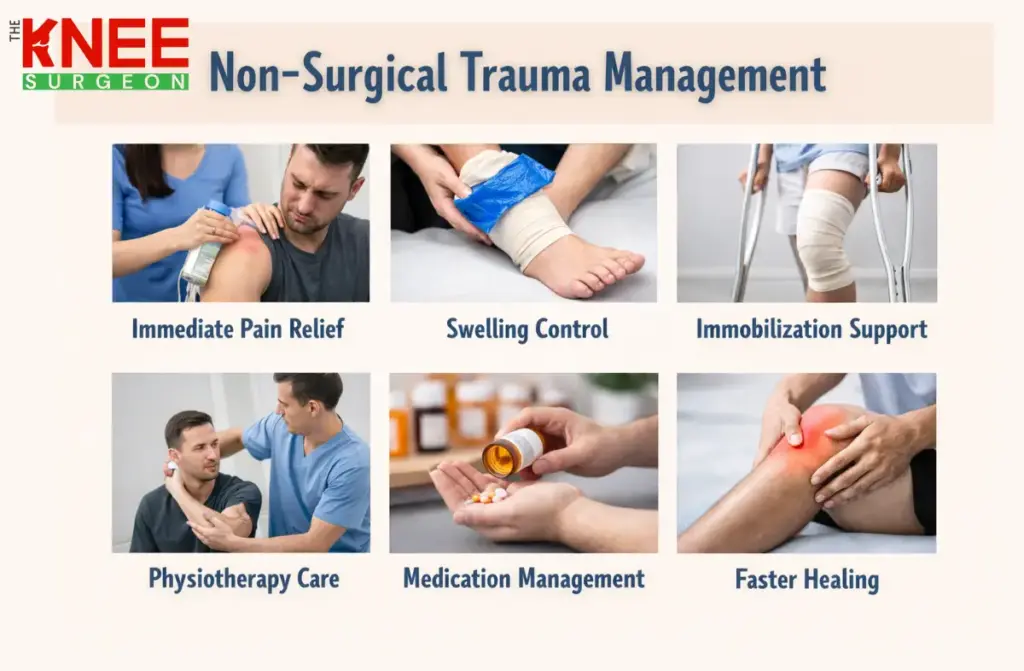
- An honest conversation about surgery versus non-surgery. Some fractures do perfectly well in a cast. Others genuinely need plates, screws, or rods. You deserve to hear the reasoning, not just a verdict.
- A recovery timeline that’s actually about you, not a generic “six to eight weeks” that gets recited to every patient regardless of age or injury type.
- Physiotherapy discussed from day one, not handed to you as an afterthought once the cast finally comes off.
- A willingness to say “this could go wrong.” Stiffness, slow healing, or the small chance of needing a second procedure later, these aren’t things a good doctor hides from you to sound reassuring.
What Kinds of Injuries Fall Into This Category
- Fractures in the arms, legs, pelvis, or spine that need a proper fixation plan once the emergency phase is over
- Joint injuries to the knee, shoulder, hip, or ankle, where instability doesn’t always show up clearly on that first X-ray
- Ligament and tendon tears, often missed on an X-ray because they need an MRI to actually see
- Old injuries resurfacing as arthritis, sometimes decades after the original accident
- Bones that healed a little crooked, or didn’t heal quite on schedule, occasionally needing a corrective procedure
- Work-related injuries, where getting back to your job matters just as much as the medical fix itself
What Actually Makes Someone “The Best Orthopedic Doctor,” Not Just Another Name on a List
A lot of people typing “best orthopedic doctor in Chennai” into Google aren’t asking about trauma specifically, they’re asking a bigger question: who do I actually trust with this? A few things tend to separate the surgeons worth seeing from the rest:
They explain the why, not just the what. If every visit ends with “you need surgery” and nothing more, ask what the alternative would have looked like, and why it wasn’t chosen.
They’ve seen your specific kind of injury before, not just orthopedics in general. Someone who regularly handles tricky or repeat cases tends to catch things a generalist might miss.
They loop in physiotherapy early, instead of treating it as a footnote at the end of your file.
They’re upfront about what a scan can and can’t tell them. A doctor who says “let’s get one more image to be sure” is being more careful with you than one who sounds certain based on very little.
How Doctors Actually Figure Out What’s Wrong
- X-rays are usually step one, showing the fracture itself and how aligned the bone is.
- CT scans come in for trickier injuries, especially around the pelvis, spine, or joint surfaces, where an X-ray alone doesn’t tell the whole story.
- MRI scans are for soft tissue, ligaments, and cartilage, the stuff that simply doesn’t show up on a regular X-ray.
- A hands-on physical check, testing movement, strength, and stability, often reveals more than any scan does.
Why Your Recovery Won’t Match Your Cousin’s Recovery
One of the most common complaints I hear is some version of “the doctor said six weeks, and it’s been ten, and I still can’t walk properly.” That frustration usually comes from being given a one-size-fits-all number instead of a real answer. Recovery actually depends on:
- Where the break is, and how bad it was. A small hairline crack in a finger and a shattered bone near a major joint are simply not the same recovery.
- Age and general bone health. The same fracture in a 30-year-old and a 70-year-old can heal at very different speeds.
- Whether surgery happened or not. Oddly enough, surgically fixed fractures sometimes allow earlier movement than a fracture left to heal in a cast alone.
- How seriously physiotherapy was taken. This one’s controllable, and it often matters more than the surgery itself.
A surgeon worth your trust will give you a range based on your actual injury, and tell you honestly what would speed things up or slow things down for you personally, instead of quoting a number that applies to nobody in particular.
About Dr. Vijay Kumar Sohanlal
Dr. Vijay Kumar Sohanlal has spent over 18+ years in orthopaedics and joint replacement surgery, holding an MBBS and MS in Orthopaedics, with further training in Germany and Australia. He currently practises as Senior Joint Replacement Surgeon at MGM Healthcare in Aminjikarai, and consults at MAHI Hospitals in Kilpauk, where patients come to him for both joint conditions and the kind of definitive fracture care that starts once the emergency phase is behind them.
Real Patient
I came here for my shoulder clavicle fracture and undergone surgery. Dr Vijay an amazing Dr and lovely person carried out my surgery. It went well. Lovely clean and neat Hospital and all the staff and Drs associated were excellent. Lovely care given by the hospital.
In total excellent is the only word I can say. Thank you
Conclusion
Here’s the thing about fractures and injuries that nobody says out loud: getting hurt is the easy part to understand. Everyone knows what a broken bone looks like on an X-ray. What’s harder to figure out, on your own, with no medical background, is everything that comes after: whether the healing is actually going the way it should, whether that lingering stiffness is normal or a warning sign, and whether the person treating you now is the right one to see it through.
That’s not a question you’re meant to answer alone, and it’s not one an emergency room is built to answer either. It takes someone willing to slow down, actually look at your scans with you, and tell you the truth even when the truth is “let’s wait and see” instead of “let’s operate.”
If you or someone you love is somewhere in that in-between stage, past the emergency, not quite sure what happens next, that’s exactly the conversation worth having. Dr. Vijay Kumar Sohanlal sees patients for this at MGM Healthcare in Aminjikarai and at Mahi Joint Replacement and Orthopedic Clinic in Kilpauk, and the first visit is simply about understanding where things actually stand with your injury, no pressure, no rushed five-minute verdict.
Book a consultation with Dr. Vijay Kumar Sohanlal
📞 +91 91597 11355
Read More: Vertebroplasty for spinal fracture.