Medically Reviewed by Dr. Vijay Kumar Sohanlal, MBBS, MS (Orthopaedics)
Orthopaedic & Joint Replacement Surgeon | 18+ years of clinical experience
Fellowship training: Mumbai, Germany, Australia
Founder & Owner of MAHI Multispeciality Hospitals, Kilpauk, Chennai
& Senior Joint Replacement Surgeon at MGM Healthcare
Last medically reviewed: October 2026
Short answer: If knee or hip pain limits your walking, stairs, or sleep, and medicines and exercises no longer help enough, it may be time to meet a joint replacement surgeon. A consultation does not mean you will need surgery. Many patients are first guided through non-surgical options.
I am Dr. Vijay Kumar Sohanlal, a orthopaedic surgeon and joint replacement specialist in Chennai at MAHI Hospitals, MGM Healthcare, Purasaiwakkam, Chennai. This page explains how joint problems are evaluated, what your options are, and what to expect, in plain language, so you can decide with confidence.
Book an Appointment | Call +91 91597 11355
About Your Joint Replacement Surgeon
Dr. Vijay Kumar Sohanlal is a Senior Joint Replacement and Orthopaedic Consultant with 24+ years of experience overall, including 19 years as a specialist.
- Education: MBBS, Mysore University; MS Orthopaedics, Sri Ramachandra University
- Fellowships: Joint Replacement (computer-assisted) and Arthroscopy, at centres in Australia, Germany, and India
- Expertise: total knee replacement, total hip replacement, revision knee and hip replacement, avascular necrosis (AVN) of the hip, arthroscopic surgery, complex fractures, and polytrauma
What is Joint Replacement?
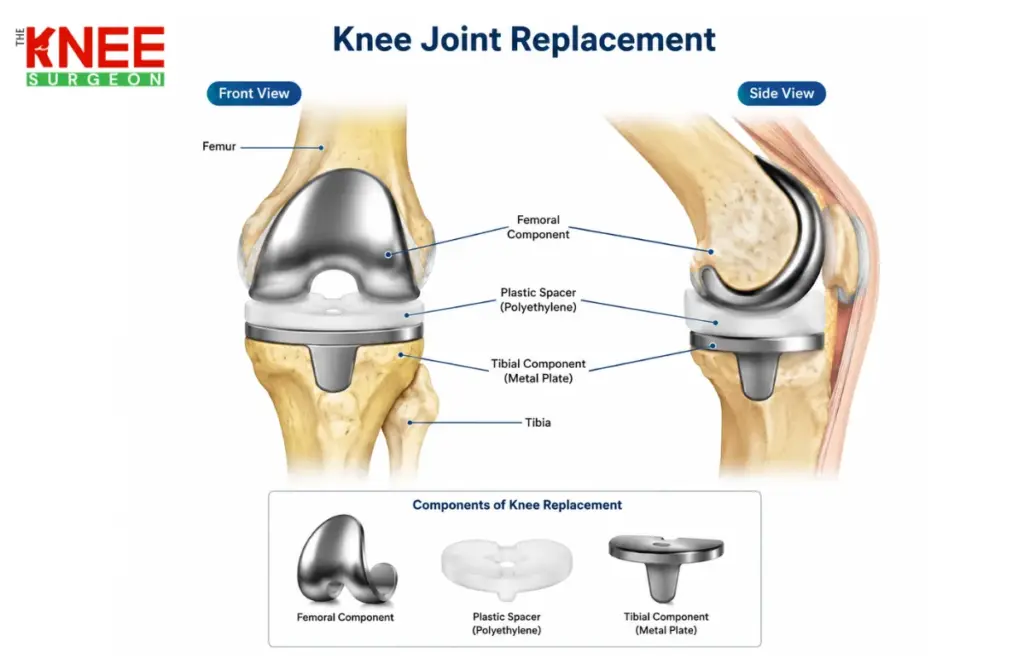
Joint replacement is surgery in which the damaged surfaces of a joint are replaced with artificial parts, called an implant or prosthesis. The goal is to reduce pain and help you move more comfortably.
- Total knee replacement: the worn ends of the thigh bone (femur) and shin bone (tibia) are resurfaced.
- Total hip replacement: the damaged ball and socket of the hip are replaced.
- Revision replacement: an earlier replacement that has worn, loosened, or become painful is redone.
Surgery is generally considered only after other treatments have not given enough relief.
Is it Time to See a Joint Replacement Specialist?
Tick any that sound familiar:
- Pain has lasted several weeks or months
- Walking short distances or climbing stairs is difficult
- Pain wakes you at night
- Medicines, physiotherapy, or injections no longer help enough
- Your knee or hip looks deformed or keeps swelling
- You avoid sitting cross-legged, using an Indian-style toilet, or going out because of pain
- A past joint replacement has become painful or loose
If you ticked even one or two, a consultation can give you clarity. Many patients are advised non-surgical care first.
Seek urgent medical care if you have:
- Sudden, severe joint pain
- Inability to bear weight on the leg
- Swelling with fever, redness, or warmth
- Numbness, tingling, or loss of feeling in the leg
- A joint that looks out of shape after an injury
Common Symptoms of Knee and Hip Arthritis
- Pain that worsens with walking, standing, or stairs
- Morning stiffness or stiffness after sitting
- Swelling around the joint
- Grinding or cracking sensations
- Groin, thigh, or buttock pain (common in hip problems)
- Knees bending inward or outward
- Reduced range of movement
What Causes Joint Pain and Arthritis?
In a healthy joint, smooth cartilage cushions the bones. When it wears away, bones rub together, causing pain and stiffness.
- Osteoarthritis: wear-and-tear arthritis, the most common cause
- Rheumatoid arthritis: an autoimmune condition inflaming the joint lining
- Avascular necrosis (AVN): bone in the hip loses blood supply and weakens
- Post-injury arthritis: after a fracture or ligament injury
- Other factors: excess body weight, family history, previous joint surgery
How Joint Problems Are Diagnosed
Diagnosis begins with a conversation about your symptoms and daily activities, followed by a physical examination.
- X-rays show joint space, bone changes, and alignment
- MRI, in selected cases, shows cartilage, ligaments, and bone blood supply (important in AVN)
- Blood tests, if an inflammatory condition is suspected
Treatment Options at a Glance
| Option | What it involves | May suit |
| Lifestyle and weight management | Activity changes, weight reduction | Early arthritis |
| Physiotherapy | Strengthening, flexibility, walking training | Early to moderate arthritis |
| Medicines and supports | Pain relief as prescribed; walking aids | Short-term and ongoing symptom control |
| Joint injections | Injected into the joint, where appropriate | Selected patients |
| Arthroscopy (keyhole surgery) | Small incisions with a camera | Selected joint problems |
| Total knee or hip replacement | Damaged surfaces replaced with implants | Advanced arthritis not relieved by other care |
| Revision replacement | Redoing a worn or loosened implant | Patients with problems after a previous replacement |
The right choice depends on your examination, X-rays, age, general health, and goals. It is decided together with your surgeon.
Computer-Assisted Joint Replacement
Computer-assisted surgery uses navigation technology to help the surgeon plan and position the implant accurately. The surgeon stays in full control of the operation. Dr. Vijay Kumar Sohanlal has completed fellowship training in computer-assisted joint replacement. Whether it suits your case will be discussed at your consultation.
Knee Replacement on Both Sides (Bilateral)
If both knees are affected, some patients ask about replacing both. Depending on your age, heart and lung health, and recovery goals, your surgeon may suggest doing both knees in one admission or in two stages. This is decided case by case after a full health assessment.
What to Expect
Before surgery
You will have a check-up and tests to confirm you are fit for surgery. Your doctor will explain the procedure, review your medicines (especially for diabetes, blood pressure, or blood thinners), and answer your questions. Some patients are advised to begin simple strengthening exercises beforehand.
During surgery
The operation is done under anaesthesia, which your anaesthetist will discuss with you. The surgeon removes the damaged surfaces, fits the implant, and closes the incision. Surgery typically takes about one to two hours, and most patients stay in hospital for around 3 to 5 days. These are general estimates; your own timeline depends on your health and the procedure.
Recovery Timeline
Recovery differs for every patient. A general outline:
- First days: Pain control and gentle movement begin early, with physiotherapy often starting within a day of surgery.
- First few weeks: You walk further and build strength. Swelling and stiffness are common and gradually ease.
- About 6 to 12 weeks: Many people return to light daily activities. Your surgeon will guide you on driving and work.
- Several months: Strength and comfort keep improving. Full recovery can take up to a year for some patients.
Following your physiotherapy plan carefully is one of the most important parts of a good recovery.
Risks of Joint Replacement
Joint replacement is a well-established surgery, but like any operation it has risks:
- Infection
- Blood clots in the leg veins
- Stiffness or limited movement
- Persistent pain or swelling in some patients
- Implant loosening or wear over many years
- Anaesthesia-related risks
- Injury to nearby nerves or blood vessels (uncommon)
Your surgeon will explain how these apply to you and what is done to reduce them. Conditions such as diabetes or heart disease can affect risk, so please share your full medical history.
Cost of Joint Replacement in Chennai
The cost of knee or hip replacement varies from patient to patient. The main factors are:
- The type of procedure (primary or revision; one knee or both)
- The type and quality of implant chosen
- Whether computer-assisted or robotic technology is used
- Room category and length of hospital stay
- Tests, medicines, and physiotherapy
- Any other medical conditions needing care
Protecting Your Joints
- Maintain a healthy weight
- Stay active with low-impact exercise such as walking, swimming, or cycling
- Strengthen the muscles around your knees and hips
- Warm up before exercise
- Get joint injuries checked and treated properly
- Do not ignore persistent pain
Preparing for Your First Consultation
Please bring:
- Previous X-rays, MRI scans, and reports
- A list of your current medicines
- Records of past surgeries or joint treatments
- A family member, if you would like support in the discussion
Questions you may want to ask:
- Do I need surgery now, or can I try other treatments first?
- What are the benefits and risks in my case?
- What will recovery look like for me?
- How should I prepare at home?
Considering Surgery for a Parent or Family Member?
Many families research joint replacement on behalf of an older parent. You are welcome to attend the consultation together. We will explain the options in simple terms, discuss the parent’s overall health and goals, and help the family make an unhurried decision.
What Patients Say
I’m excited about Dr. Vijay Kumar Sohanlal and his very surprising treatment. The best joint replacement surgeon in Chennai. My great-grandpa struggles with joint pain. I found him on YouTube. His videos and explanations are very impressive. We decided to take treatment only at Mahi Clinic. He did a joint replacement for my great-grandpa; he is very fine now. Thank you, Dr. Vijay Kumar Sohanlal, and the excellent team.
Visit Our Clinic in Purasaiwakkam, Chennai
MAHI Joint Replacement and Orthopaedic Clinic (MGM Healthcare) 118, Poonamallee High Road, Purasaiwakkam, Chennai, Tamil Nadu 600084
Phone: +91 91597 11355
Timings: Monday to Saturday, 9:00 AM to 8:00 PM
Patients visit us from Purasaiwakkam, Vepery, Kilpauk, Perambur, and other parts of Chennai. If joint pain is affecting your daily life, you are welcome to schedule a consultation. We will review your symptoms and X-rays, explain your options, and help you decide at your own pace.
Book an Appointment | Call +91 91597 11355 of approach is based on what suits your joint, not on what a clinic happens to offer.
Read More: Orthopedic Surgeon in Chennai.