

Medically Reviewed by: Dr. Vijay Kumar Sohanlal, MBBS, MS (Orthopaedics), Orthopaedic & Joint Replacement Surgeon, Founder & Owner, MAHI Multispeciality Hospitals, Kilpauk, Chennai.
Last medically reviewed: October 2026
Knee pain can affect much more than walking. It may make climbing stairs difficult, interrupt sleep, or turn everyday activities such as getting up from a chair into a challenge. When these problems continue, understanding the cause is an important first step towards finding appropriate treatment.
Knee replacement is one option for people with significant damage to the knee joint. It involves replacing damaged joint surfaces with artificial components. However, surgery is not necessary for everyone with knee pain. The decision depends on the underlying condition, the severity of symptoms, the effect on daily activities and the response to other treatments.
This guide explains how knee problems are evaluated by a knee replacement surgeon in India, when knee replacement may be considered, the available surgical options, what to expect during recovery, and how to prepare for a consultation with an orthopaedic doctor.
Why Does Knee Pain Develop?
The knee is a complex joint that supports body weight and allows the leg to bend and straighten. Pain can develop because of changes within the joint, an injury or problems affecting nearby structures.
Common causes include:
• Osteoarthritis, which gradually damages the cartilage covering the joint surfaces.
• Rheumatoid arthritis and other inflammatory joint conditions.
• Meniscus injuries affecting the cartilage that helps cushion the knee.
• Ligament injuries that may cause pain or instability.
• Post-traumatic arthritis following an injury or fracture.
• Other conditions that affect joint movement and function.
The cause of knee pain cannot always be identified from symptoms alone. An examination and appropriate investigations help establish the diagnosis and guide treatment.
When Should Knee Pain Be Assessed?
Occasional discomfort may settle with suitable care, but persistent or worsening symptoms should not be ignored.
An orthopaedic assessment may be appropriate when you experience:
• Pain while walking, standing or climbing stairs.
• Stiffness that makes bending or straightening the knee difficult.
• Recurrent swelling around the joint.
• A feeling that the knee may give way.
• Pain that interferes with sleep or everyday activities.
• Reduced mobility despite trying appropriate treatment.
These symptoms do not automatically mean that knee replacement is required. They indicate that the cause should be assessed and suitable treatment options considered.
A severely injured knee, inability to bear weight after an injury, or a hot, swollen joint accompanied by fever may require urgent medical attention.
How is the Need for Knee Replacement Determined?
The decision to consider knee replacement involves more than an X-ray or a description of pain. The doctor needs to understand the extent of joint damage and how it affects the patient’s daily life.
Medical History and Physical Examination
The consultation usually includes questions about the duration of pain, previous injuries, existing medical conditions and treatments already tried. The doctor may examine knee movement, alignment, stability, swelling and tenderness.
Imaging and Other Investigations
X-rays are commonly used to assess joint space, alignment and changes associated with arthritis. Other investigations may be recommended when necessary to clarify the diagnosis or assess a specific problem.
Reviewing Treatment Options
The doctor considers the examination findings, imaging, symptoms, general health and the patient’s functional needs. If surgery is being considered, the discussion should include its potential benefits, limitations, risks and alternatives.
The aim is to select a treatment plan that fits the individual condition rather than assuming that the same approach is suitable for every patient.
Treatment Options Before Surgery
Not every person with knee arthritis needs a knee replacement. Depending on the diagnosis and severity, non-surgical care may help manage symptoms and maintain function.
Physiotherapy and Exercise
A suitable exercise programme may help strengthen the muscles around the knee, improve movement and support everyday activities. Exercises should be adapted to the patient’s condition and physical ability.
Medication and Pain Management
Medication may help relieve pain or inflammation in selected patients. The choice depends on medical history, existing medicines and possible side effects. Patients should seek appropriate medical advice before starting or changing medication.
Activity Modification and Weight Management
Adjusting activities that aggravate symptoms may help some patients remain active more comfortably. For people for whom it is appropriate, weight management can reduce the load placed on the knee joint.
Further Clinical Assessment
If pain and functional limitations continue despite suitable treatment, the doctor may discuss whether surgery is an appropriate next step. The decision should take account of the patient’s needs, medical condition and understanding of the available choices.
Types of Knee Replacement Surgery
The procedure depends on the extent and location of joint damage.
Total Knee Replacement
Total knee replacement involves replacing the damaged surfaces of the knee joint with artificial components. It may be considered for advanced arthritis when persistent pain and reduced mobility remain troublesome despite appropriate non-surgical treatment.
The procedure and implant selection are planned according to the patient’s anatomy, joint condition and clinical needs.
Partial Knee Replacement
Partial knee replacement involves replacing the damaged compartment of the knee while preserving the parts of the joint that remain suitable. It may be an option for selected patients whose damage is limited to a particular area.
Suitability depends on the condition of the other compartments, ligament function, alignment and other clinical findings.
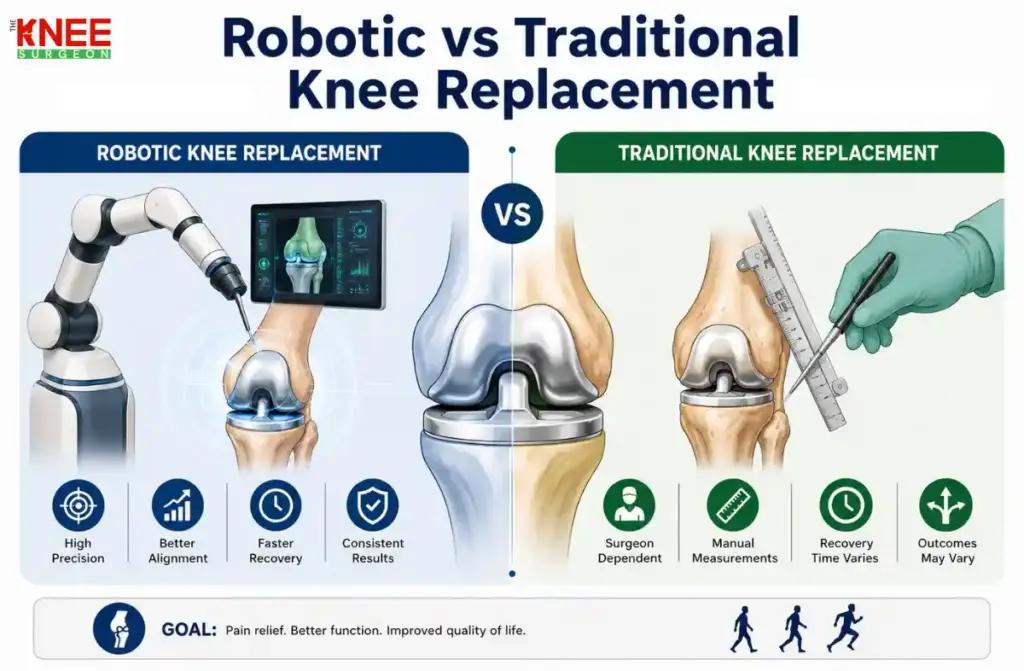
Robotic-Assisted Knee Replacement
Robotic-assisted systems can help the surgical team plan aspects of the procedure and guide certain steps during implant placement. The surgeon remains responsible for the operation and for making clinical decisions.
Robotic assistance is not automatically the right choice for every patient. Its suitability depends on the clinical situation, the available equipment and the surgeon’s assessment. Patients should ask how the proposed technique may be relevant to their particular condition and whether conventional surgery is also appropriate.
What Should You Know Before Agreeing to Surgery?
Knee replacement is a major procedure, so patients should have a clear understanding of what it involves before making a decision.
A pre-operative discussion should cover:
• Why the procedure is being recommended.
• Whether other reasonable treatments are available.
• The type of knee replacement being considered.
• Potential benefits and limitations.
• Individual risk factors and possible complications.
• Anaesthesia, hospital care and discharge planning.
• Rehabilitation and follow-up arrangements.
Possible complications include infection, blood clots, stiffness, persistent pain, implant-related problems and the need for further surgery. Individual risks vary with health status and the procedure.
Patients should have sufficient information and time to discuss concerns before consenting to surgery. No procedure can guarantee a particular outcome.
Preparing for Knee Replacement
Preparation depends on the patient’s health, mobility and the planned procedure. The treating team may review existing medical conditions, current medications, relevant investigations and general fitness for surgery.
Patients may also need to plan for assistance at home, transport after discharge and a suitable space for moving around safely.
Before the procedure, it is useful to clarify who will coordinate rehabilitation, when follow-up appointments are expected and which symptoms should be reported promptly.
Recovery After Knee Replacement
Recovery varies from person to person. Age, general health, strength before surgery, the procedure performed and progress with rehabilitation can all influence the recovery process.
Early Movement and Hospital Care
The healthcare team provides instructions on pain management, wound care, movement and prevention of complications. Depending on the patient’s condition, standing and walking with assistance may begin early under supervision.
Physiotherapy and Exercise
Rehabilitation helps patients work towards improved movement, strength and function. The programme may include knee movement exercises, muscle strengthening and walking practice. Patients should follow their treating team’s instructions and progress at a pace suited to their recovery.
Returning to Daily Activities
The timing of a return to driving, work, household activities and exercise depends on individual progress and medical advice. Patients should not assume that everyone follows the same recovery timeline.
New or worsening pain, fever, wound discharge or sudden swelling should be reported to the treating team. Chest pain or sudden difficulty breathing after surgery requires emergency medical attention.
What Influences the Cost of Knee Replacement in India?
The cost of knee replacement varies between hospitals and individual cases. A general online estimate may not reflect the total amount a patient will need to pay.
Factors that can affect the cost include:
• The type of procedure and whether one or both knees are treated.
• The implant and materials selected.
• Whether robotic assistance is used.
• Hospital accommodation and length of stay.
• Investigations, anaesthesia and medicines.
• Rehabilitation and follow-up care.
• Insurance coverage and policy conditions.
Patients should request an itemised estimate from the hospital and confirm what is included. It is also sensible to ask whether additional charges may arise if the hospital stay or treatment plan changes.
About Dr Vijay Kumar Sohanlal
Dr Vijay Kumar Sohanlal is an orthopaedic doctor based in Chennai. His published professional profile lists an MBBS from Mysore University and an MS in Orthopaedics from Sri Ramachandra University in Chennai.
The website describes further training and professional exposure in joint replacement and arthroplasty, including experience gained through training in India and overseas. It also describes his clinical work in knee and hip replacement and his practice associations in Chennai.
The website identifies Dr Vijay Kumar Sohanlal as the founder and owner of MAHI Multispeciality Hospitals in Kilpauk and lists a professional association with MGM Healthcare in Chennai. Current appointments, operating locations and hospital affiliations should be confirmed directly with the respective institutions.
These details are intended to provide factual professional background rather than a comparative endorsement. Qualifications, fellowship titles, specialist designations and registration details should be verified against official records before publication.
For a patient considering knee replacement, a consultation should focus on understanding the knee condition, reviewing relevant investigations, discussing appropriate treatment options and explaining the potential risks and recovery requirements. Whether surgery is suitable depends on the individual’s clinical assessment.