Medically Reviewed by: Dr. Vijay Kumar Sohanlal, MBBS, MS (Orthopaedics), Orthopaedic & Joint Replacement Surgeon, Founder & Owner, MAHI Multispeciality Hospitals, Kilpauk, Chennai.
Last medically reviewed: August 2026
Why People Search for a Robotic Knee Surgeon in Chennai
Most people who search for a robotic knee surgeon in Chennai have already tried the usual first steps. Physiotherapy, painkillers, maybe an injection or two. For a while it worked, and then it stopped. What’s left is a knee that limits real decisions: whether to take the stairs or the lift, whether a trip involves a lot of walking, whether kneeling down to play with a grandchild is worth the pain afterward.
Robotic knee replacement has become one of the more searched terms in orthopaedics over the past few years, and for good reason. It genuinely changes how precisely an implant can be positioned. But it is also a term that gets used loosely in marketing, so it is worth understanding clearly, not just being told it is “advanced.”
This page covers what robotic knee replacement actually involves, who it is suited for, and what consulting Dr. Vijay Kumar Sohanlal at Kilpauk or Aminjikarai looks like in practice.
About Dr. Vijay Kumar Sohanlal, Robotic Knee Surgeon in Chennai
Dr. Vijay Kumar Sohanlal has practised orthopaedics in Chennai for over 18+ years, with more than 10,000 orthopaedic surgeries performed across his career, including robotic and conventional joint replacement. He trained internationally in Germany and Australia and previously led the robotic joint replacement programme at Medway Hospitals, before moving into his current role as senior joint replacement surgeon at MGM Healthcare, alongside his own clinic at Kilpauk.
What patients tend to describe after a consultation is not the technology itself, but how clearly it gets explained. Robotic surgery is a genuinely technical subject, and a good surgeon translates it instead of leaning on the word “robotic” as a selling point on its own.
Where he practises:
- Owner and Founder: MAHI Multispeciality Hospitals, No 118, Poonamallee High Road, Vepery, Chennai – 600084
- MGM Healthcare: 54, Nelson Manickam Rd, Aminjikarai, Chennai 600029
Qualifications: MBBS, MS (Orthopaedics), Advanced Fellowship in Joint Replacement Surgery, international training in Germany and Australia.
⭐ Patient Ratings
Google: 4.5 ★ | Justdial: 4.8 ★ | Practo: 4.7 ★
What Robotic Knee Replacement Actually Is
There is a common misunderstanding that robotic surgery means a machine operating on its own. It does not. The robotic system works more like a highly precise guide than an independent operator. The surgeon plans the surgery, makes every decision, and performs the procedure. The robotic arm simply helps carry out that plan with a level of consistency that manual instruments cannot always match.
Before surgery, imaging is used to build a 3D model of the patient’s knee. That model becomes the surgical blueprint, showing exactly where bone cuts should be made and how the implant should sit for that specific joint, not a generic average knee. During surgery, the robotic arm operates within the boundaries set by that plan, while the surgeon stays in full control, checking and adjusting alignment in real time rather than relying purely on visual judgement.
Robotic vs Conventional Knee Replacement: An Honest Comparison
This is the question almost every patient asks, and it deserves a straight answer rather than a sales pitch.
| Factor | Conventional Knee Replacement | Robotic-Assisted Knee Replacement |
| Surgical planning | Based on X-rays and the surgeon’s intraoperative judgement | Based on a CT-generated 3D model built before surgery |
| Precision | Skilled, but manual, with natural variation between cases | Sub-millimetre accuracy in bone cuts and implant placement |
| Soft tissue impact | Slightly more disruption in some cases | Generally less disruption to surrounding tissue |
| Suitability | Works well for straightforward, well-aligned knees | Particularly useful for complex deformities or unusual anatomy |
| Cost | Lower | Higher, due to technology and planning involved |
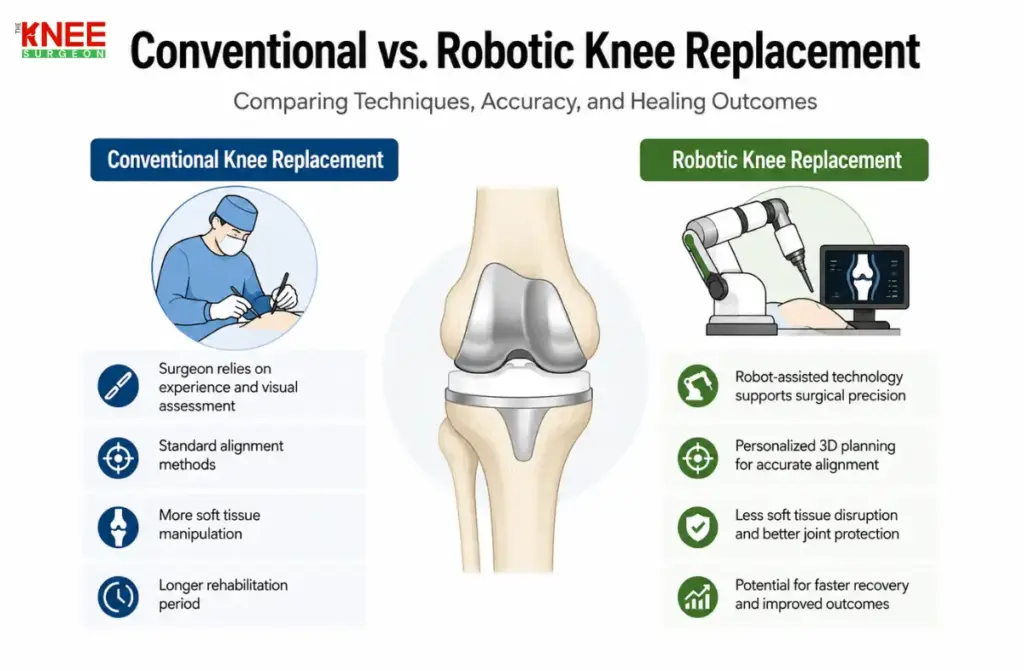
Robotic assistance is not automatically the better option for every patient. For a straightforward knee with normal alignment, a well-performed conventional replacement can deliver very similar results. Where robotic precision matters most is in knees with significant deformity, prior injury, or atypical anatomy, situations where manual judgement alone has less margin for error. A trustworthy robotic knee surgeon in Chennai will tell you honestly which category your knee falls into, rather than defaulting to the more expensive option for everyone.
Who Actually Needs a Robotic Knee Surgeon in Chennai?
Not every knee ache means surgery is the next step. A good robotic knee specialist will say this plainly in the first consultation rather than moving straight to a surgical recommendation.
Signs surgery may be worth discussing:
- Persistent pain while walking, standing, or climbing stairs that has lasted months, not days
- Swelling and stiffness that does not fully settle with rest
- A visible deformity, such as bow-leggedness, that has gradually worsened
- A grinding or locking sensation during movement
- Pain that consistently disrupts sleep
When non-surgical treatment has run its course: Physiotherapy, medication, and activity changes work well for many people, sometimes for years. Surgery becomes a reasonable option once these approaches stop making a real difference to daily comfort, not before.
Robotic knee replacement is most commonly performed in patients between 55 and 80, though it is not strictly limited by age. Younger patients with severe joint damage can also benefit, particularly since robotic precision tends to support longer implant life. Conditions such as diabetes or blood pressure are usually reviewed and stabilised before surgery is scheduled.
What to Expect: Consultation Through Recovery
- First consultation. A detailed review of symptoms, medical history, and how the pain has actually affected daily life, followed by a plain-language explanation of findings and options, including whether surgery is even necessary yet.
- Imaging and planning. If surgery is the right path, a CT scan builds the 3D model used to plan bone cuts and implant position before you ever enter the operating theatre.
- Surgery day. The procedure itself typically takes 60 to 90 minutes, with total time in the operating room, including anaesthesia, usually around 2 to 2.5 hours.
- First 24 hours. Most patients sit up and begin gentle movement within hours of surgery, with some taking assisted first steps within 6 to 12 hours.
- First month. Early days focus on swelling control and building confidence with a walker. By weeks two and three, many patients move to a walking stick as physiotherapy intensifies.
- Weeks 4 to 6. Most patients are walking without an aid, and desk-based work often resumes in this window, once cleared by the surgeon.
- 3 to 12 months. Walking comfortably over longer distances and managing stairs typically develops by three months, with continued improvement in strength and flexibility through six months, and full recovery generally by nine to twelve months.
The one variable that consistently affects this timeline is how closely a patient sticks to physiotherapy in the first six weeks. Skipping sessions early on tends to slow everything that follows, regardless of how well the surgery itself went.
Is Robotic Knee Replacement Safe?
Every surgery carries some risk, and being upfront about that is part of responsible care, not a weakness in the pitch.
The robotic system creates a virtual boundary around the planned surgical area. If the instrument moves beyond that boundary, the robotic arm resists, protecting healthy bone and tissue that should not be touched. Alignment can be checked and adjusted during surgery itself, rather than only being confirmed afterward as with fully manual techniques.
Standard surgical risks, infection, blood clots, and anaesthesia-related concerns, are managed through pre-operative screening, sterile technique, and early mobilisation after surgery. Post-operative monitoring is designed to catch early warning signs before they become bigger problems.
Patient Reviews and Testimonials
It’s truly a pleasure to be associated with a doctor like you, Dr. Vijay. Being your patient for so long, and seeing the excellent care you gave my father during his surgery, speaks volumes about your dedication and expertise.
Your commitment towards your patients, your kindness, and the confidence you give us is something we deeply value. Wishing you all the very best for your new venture, Mahi Clinic. I’m sure it will touch many more lives and bring comfort and healing to countless families.
Thank you for always being there for us. Grateful to have a doctor like you.
I’m excited about Dr. Vijay Kumar Sohanlal and his very surprising treatment. The best joint replacement surgeon in Chennai. My great-grandpa struggles with joint pain. I found him on YouTube. His videos and explanations are very impressive. We decided to take treatment only at Mahi Clinic. He did a joint replacement for my great-grandpa; he is very fine now. Thank you, Dr. Vijay Kumar Sohanlal, and the excellent team.
best knee surgeon in Chennai and one of the best doctors in Chennai I have ever seen, because my mother had an orthopaedic problem for the last 5 years. We consulted more doctors, but they couldn’t cure the problem. Once we visited Dr. Vijay Kumar Sohanlal, my mom’s problem started to be cured. He is a very kind and hopeful person.
Choosing the Right Robotic Knee Surgeon in Chennai
Robotic technology is a genuine advance in knee replacement precision, but the technology alone does not make the outcome. The surgeon’s judgement in planning the case, deciding whether robotic assistance is actually needed, and guiding recovery afterward matters just as much as the equipment used.
Dr. Vijay Kumar Sohanlal consults at Mahi Clinic, Kilpauk and MGM Healthcare, Aminjikarai, six days a week, and offers a clear assessment of whether robotic knee replacement is the right next step for your specific knee. Book a consultation
ns. By combining robotic technology with personalized care, he ensures patients feel confident and supported throughout their recovery journey. Reassured that they are in the hands of a surgeon who combines advanced technology with compassionate care. Feel reassured that they are in the hands of a surgeon who combines advanced technology with compassionate care.
Conclusion
Living with chronic knee pain can significantly affect mobility, independence, and overall quality of life. Fortunately, modern robotic surgical technology now offers a highly effective solution for patients suffering from severe joint conditions. By consulting an experienced robotic knee surgeon in Chennai, patients can benefit from advanced procedures designed to restore joint function with greater precision and faster recovery. Under the care of experts such as Dr. Vijay Kumar Sohanlal, individuals receive a combination of cutting-edge technology, clinical expertise, and compassionate treatment.
His dedication to patient care, along with access to modern robotic systems, ensures that patients receive safe and reliable surgical outcomes. With the guidance of the best robotic surgeon in Chennai, many individuals are able to regain mobility, reduce pain, and return to an active and fulfilling life.