Medically reviewed by: Dr. Vijay Kumar Sohanlal, MBBS, MS (Orthopaedics), Orthopaedic and Joint Replacement Surgeon, Founder and Owner, MAHI Multispecialty Hospital, Kilpauk, Chennai
Last medically reviewed: September 2026
Quick Answer
Knee ligament surgery repairs or reconstructs a torn ACL, PCL, MCL or LCL to restore stability to the knee joint. Not every ligament tear needs an operation. Partial sprains often heal with physiotherapy and bracing, while complete tears that cause instability, locking, or repeated buckling usually need arthroscopic reconstruction. Recovery ranges from a few weeks for daily activity to nine or twelve months for a full return to competitive sport.
Why Knee Ligament Injuries Are Becoming More Common
Whether you are sprinting on a football field, taking the stairs at work, or simply walking to the market, your knee depends on four ligaments to stay stable. Over the past decade, Dr. Vijay Kumar Sohanlal has noticed a steady rise in knee ligament injuries among patients in Chennai, driven by greater participation in sport, sedentary lifestyles that weaken the supporting muscles, road traffic accidents, rising obesity, and an aging population. A torn ligament can turn a routine walk into a painful, unstable ordeal.
The good news is that orthopaedic surgery has changed considerably in the last twenty years. Minimally invasive arthroscopic techniques, better graft materials, and structured rehabilitation protocols mean most patients today regain full stability and return to the activities they care about.
The Four Ligaments That Stabilize Your Knee
| Ligament | Function | Typical Cause of Injury |
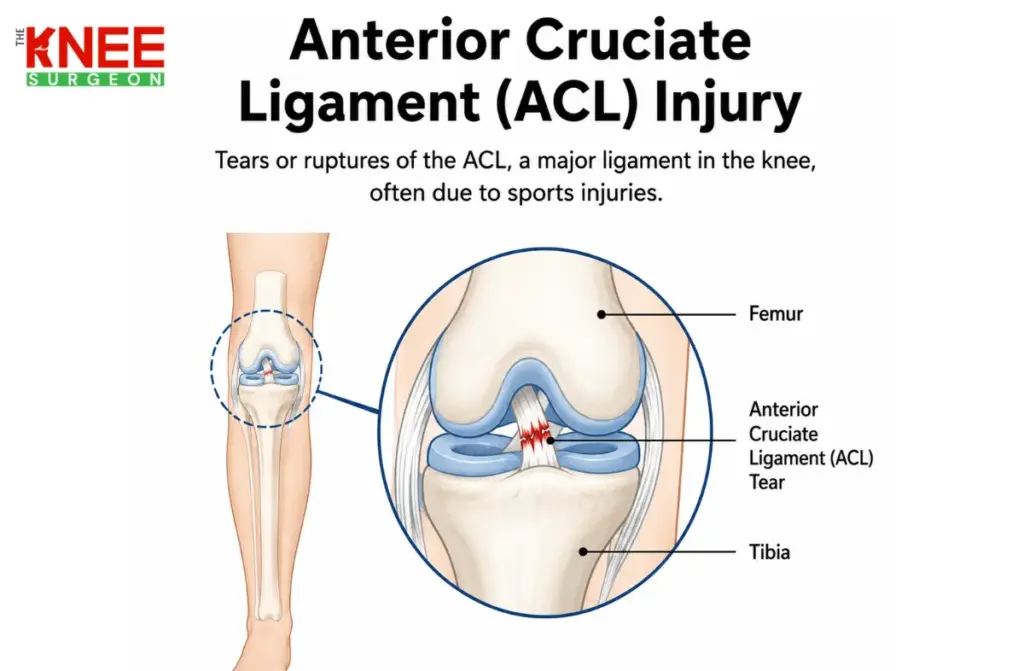
| Anterior Cruciate Ligament (ACL) | Stops the shin bone from sliding forward | Pivoting, sudden direction change, awkward landing |
| Posterior Cruciate Ligament (PCL) | Stops the shin bone from sliding backward | Direct blow to the front of the shin, dashboard injury in a car accident |
| Medial Collateral Ligament (MCL) | Stabilizes the inner side of the knee | A force pushing the knee inward |
| Lateral Collateral Ligament (LCL) | Stabilizes the outer side of the knee | A force pushing the knee outward |
The ACL is the most frequently injured of the four, particularly in sports that involve sudden stops, pivots, or jumps, such as football, basketball, and badminton.
What Causes a Knee Ligament Injury
- Sudden changes in direction during sport
- Landing awkwardly after a jump
- A direct blow during a contact sport or collision
- Twisting the knee while the foot remains planted on the ground
- Road traffic accidents, which can damage several ligaments at once
- Falls at home or at a construction site
- Gradual loss of ligament elasticity with age
Symptoms of a Torn Knee Ligament
- A popping sound or sensation at the moment of injury
- Swelling that appears within a few hours
- Sharp pain that may ease slightly but returns with movement
- A feeling that the knee is about to give way
- Difficulty putting weight on the leg
- Reduced range of motion
- Weakness or a drop in performance during sport
Ligament Injury Grades
| Grade | Description | Stability |
| Grade I | Mild stretching of the ligament fibers | Joint remains stable |
| Grade II | Partial tear with moderate damage | Some instability, moderate swelling |
| Grade III | Complete rupture of the ligament | Significant instability, often needs surgery |
The grade of injury, along with your age, activity level, and personal goals, guides whether surgery is the right path.
How Knee Ligament Injuries Are Diagnosed
Dr. Vijay Kumar Sohanlal begins every evaluation with a detailed history of how the injury happened, since the mechanism of injury often points directly to which ligament is involved. This is followed by specific clinical stability tests, including the Lachman test, the pivot shift test, the posterior drawer test, and valgus or varus stress testing depending on which side of the knee is affected.
Imaging supports the clinical exam rather than replacing it. An X-ray rules out an associated fracture, while an MRI remains the gold standard for visualizing the ligaments, meniscus, cartilage and surrounding soft tissues in detail. A CT scan is occasionally used for complex, multi ligament injuries.
When Surgery Can Be Avoided
Not every ligament injury needs an operation. Patients who may do well without surgery include:
- Those with a partial, Grade I or mild Grade II tear
- Lower demand individuals who do not need high intensity pivoting movement in daily life or sport
- Patients who regain adequate stability through a structured physiotherapy program
Initial non surgical care generally includes rest, ice, compression and elevation in the first few days, followed by a physiotherapy program to strengthen the muscles around the knee, a supportive brace during the healing phase, and anti inflammatory medication for pain and swelling.
Signs That Surgery May Be Necessary
- Persistent instability or a feeling that the knee gives way
- A complete, Grade III ligament rupture
- Injury involving more than one ligament at the same time
- Repeated episodes of the knee buckling during daily activity
- No meaningful improvement after a genuine course of physiotherapy
- A goal of returning to competitive or pivoting sport
What Happens if a Torn Ligament Is Left Untreated
Pain often eases within a few weeks even when the ligament has not healed properly, which leads many patients to delay treatment. This is a mistake Dr. Vijay Kumar Sohanlal is seen regularly in the Hospital. An unstable knee that is left untreated can lead to:
- Chronic instability, with the knee repeatedly giving way
- Additional stress on the meniscus, increasing the risk of a secondary tear
- Progressive cartilage wear from abnormal joint movement
- Earlier onset of osteoarthritis than would otherwise be expected
- Reduced speed, agility and confidence in athletes
- A higher chance of further ligament injury due to ongoing instability
Types of Knee Ligament Surgery
ACL Reconstruction
The torn ACL is removed and replaced with a graft, most commonly taken from the patient’s own hamstring tendon, patellar tendon, or quadriceps tendon, or occasionally from donor tissue. Each graft option carries a different balance of strength, harvest site discomfort, and recovery pace, which Dr. Vijay Kumar Sohanlal discusses individually with each patient before surgery. Learn more about arthroscopic ACL reconstruction.
PCL Reconstruction
Reserved for patients with a complete PCL tear and ongoing instability, since many partial PCL injuries respond well to physiotherapy alone. See arthroscopic PCL reconstruction.
MCL and LCL Repair or Reconstruction
Recommended when instability persists despite conservative treatment, particularly in cases with a complete tear or when the collateral ligament injury occurs alongside damage to another ligament.
Multi Ligament Knee Reconstruction
A more complex procedure required when two or more ligaments are torn together, most often after a high impact injury such as a road traffic accident.
All of these procedures are typically performed arthroscopically, using small incisions and a camera to guide the repair. This generally means smaller scars, less tissue disruption, lower infection risk, and a faster path through early rehabilitation compared with open surgery.
Preparing for Surgery
- A general medical evaluation and blood investigations
- Imaging review to confirm the surgical plan
- Prehabilitation exercises to strengthen the muscles around the knee before surgery
- A review of current medications
- Guidance on smoking cessation if applicable
- Preoperative fasting instructions
What Happens During Surgery
- Anesthesia is administered
- The surgeon performs an arthroscopic assessment of the joint
- Damaged tissue is removed
- The graft is prepared
- The graft is placed and fixed with specialized implants
- Stability is tested on the operating table
- The incisions are closed
Most knee ligament procedures take between one and three hours, depending on complexity and whether more than one ligament is involved.
Recovery Timeline After Knee Ligament Surgery
| Period | What to Expect |
| Week 1 | Pain and swelling management, protected walking with crutches or a brace |
| Weeks 2 to 6 | Range of motion exercises, basic strengthening begins |
| Months 2 to 4 | Progressive strength training, improved functional movement |
| Months 4 to 6 | Advanced rehabilitation, light jogging for suitable patients |
| Months 6 to 9 | Sport specific training and agility drills |
| Months 9 to 12 | Full return to competitive activity for many patients |
Return to daily activity is often possible within a few weeks. Office based work is typically resumed in two to six weeks, physical labor in three to six months, and running around four to six months, though every timeline depends on the ligament involved and how consistently rehabilitation is followed.
Why Rehabilitation Matters as Much as the Surgery
Surgery restores the structure of the knee, but rehabilitation restores its function. Skipping stages of physiotherapy is one of the most common reasons patients end up with residual weakness or a second injury. A typical program moves through mobility restoration, strength development, balance training, and finally sport specific conditioning, using exercises such as straight leg raises, quadriceps and hamstring strengthening, stationary cycling, and balance drills.
Success Rates and Risks
Modern ligament reconstruction, particularly ACL reconstruction, reports success rates above 85 to 95 percent when patients complete their rehabilitation program as prescribed. Outcomes depend on surgeon experience, how closely rehabilitation is followed, the patient’s age and fitness, and the original severity of the injury.
As with any surgery, risks exist and include infection, blood clots, graft failure, joint stiffness, persistent instability, nerve irritation, and re-injury. These risks are reduced significantly by choosing an experienced surgeon, following the rehabilitation plan closely, and attending all follow up appointments.
Choosing the Right Surgeon
The outcome of knee ligament surgery depends as much on the surgeon’s experience as on the procedure itself. When evaluating an orthopaedic surgeon for ACL, PCL, MCL or LCL surgery, consider:
- Direct experience with the specific ligament reconstruction you need
- Focus on sports medicine and knee preservation
- Access to arthroscopic techniques and modern imaging
- A track record of patient outcomes and genuine reviews
Dr. Vijay Kumar Sohanlal brings over 18+ years of orthopaedic experience, fellowship training in Germany and Australia, and prior senior consultant roles at Fortis and MGM Healthcare to every knee ligament case he manages in Chennai.
Myths and Facts About Knee Ligament Surgery
| Myth | Fact |
| Every ligament tear needs surgery | Many partial tears heal well with physiotherapy and bracing alone |
| Surgery is only for professional athletes | Anyone with meaningful instability or functional limitation may benefit |
| Recovery takes several years | Most patients return to normal activity within months, full recovery can take up to a year |
| You will never play sports again after surgery | Many athletes return successfully to competitive sport after proper rehabilitation |
| Surgery alone guarantees recovery | Physiotherapy is equally important to the outcome |
| Older adults cannot have ligament reconstruction | Treatment decisions depend on activity level and overall health, not age alone |
A Patient Recovery Journey
best knee surgeon in Chennai and one of the best doctors in Chennai I have ever seen, because my mother had an orthopaedic problem for the last 5 years. We consulted more doctors, but they couldn’t cure the problem. Once we visited Dr. Vijay Sohanlal, my mom’s problem started to be cured. He is a very kind and hopeful person.
Incredibly knowledgeable and professional.
He & his staff took great care with me and gave great instructions that really helped me to recover quickly and well. I highly recommend Dr. Vijay Kumar Sohanlal!
Really good place Ortho. Good Ambience. Good place physiotherapy and good physiotherapist. Well experience Dr.
Conclusion
A torn knee ligament can feel like it has taken away your mobility and your confidence in one moment, but modern orthopaedic care has changed what recovery looks like. Whether your case calls for physiotherapy alone or a full reconstruction, the outcome depends far more on an accurate diagnosis, the right surgical decision, and disciplined rehabilitation than on the injury itself.
Dr. Vijay Kumar Sohanlal’s experience across thousands of knee cases in Chennai shows the same result again and again: patients who get evaluated early and commit to their rehabilitation plan generally return to the life and activity they had before the injury. If your knee feels unstable or keeps giving way, do not wait for it to settle on its own, get it assessed.
Read More: Best Robotic Surgeon in Kilpauk.