Medically reviewed by: Dr. Vijay Kumar Sohanlal, MBBS, MS (Orthopaedics), Orthopaedic and Joint Replacement Surgeon, Founder and Owner, MAHI Multispecialty Hospital, Kilpauk, Chennai
Last medically reviewed: September 2026
Quick Answer
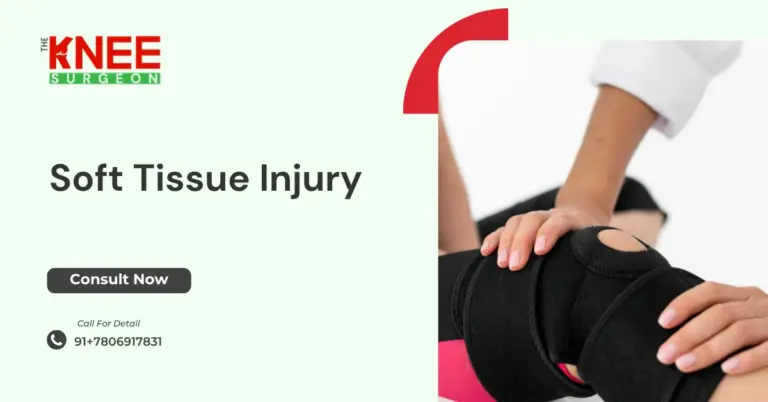
A knee soft tissue injury is damage to the ligaments, tendons, muscles, meniscus or bursa that surround and support the knee joint, rather than damage to bone. The most common examples are ACL and MCL sprains, meniscus tears, patellar tendinitis and prepatellar bursitis. Most mild to moderate injuries heal with structured rehabilitation over four to twelve weeks. Grade three tears, especially of the ACL or meniscus, often need arthroscopic surgery to restore stability.
Why the Knee is So Prone to Soft Tissue Injury
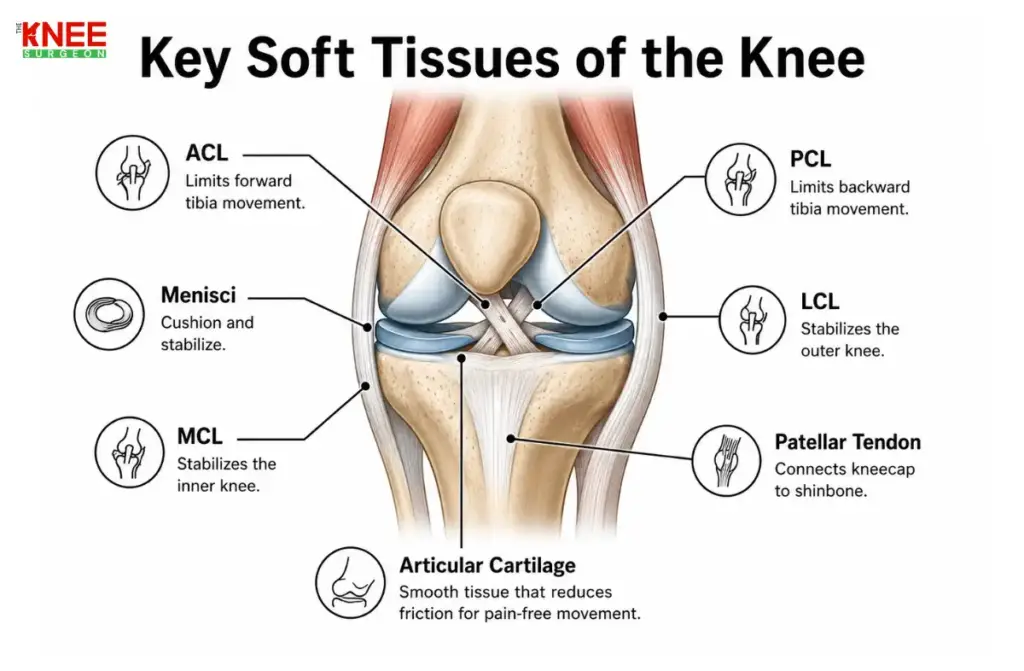
Dr. Vijay Kumar Sohanlal, an orthopaedic and joint replacement surgeon in Chennai with over 18+ years of clinical experience and fellowship training in Germany and Australia, sees this pattern again and again in his practice. The knee is not protected by a deep socket the way the hip is. It relies almost entirely on soft tissue, four main ligaments, two menisci, several tendons and a set of bursae, to stay stable while carrying full body weight through walking, squatting, climbing stairs and sport.
That design gives the knee incredible range of motion, but it also means the joint has very little margin for error when a sudden twist, a hard landing or years of repetitive load push these tissues past what they can absorb.
This is why knee soft tissue injury is one of the most common reasons patients walk into an orthopaedic clinic, whether they are a college athlete, a working professional who plays weekend badminton, or someone in their fifties who felt a sudden give while getting off a bus.
The Knee’s Soft Tissue Structures
| Structure | Role | Typical Injury |
| Anterior Cruciate Ligament (ACL) | Stops the shin bone from sliding forward | Sprain or complete tear, usually from pivoting or landing |
| Posterior Cruciate Ligament (PCL) | Stops the shin bone from sliding backward | Sprain from a direct blow to the front of the shin |
| Medial Collateral Ligament (MCL) | Stabilizes the inner knee | Sprain from a sideways force to the outer knee |
| Lateral Collateral Ligament (LCL) | Stabilizes the outer knee | Sprain from a sideways force to the inner knee |
| Meniscus (medial and lateral) | Cushions and distributes load between thigh and shin bone | Tear from twisting on a planted foot |
| Patellar Tendon | Connects kneecap to shin bone, powers extension | Tendinitis or, rarely, rupture |
| Iliotibial (IT) Band | Runs along the outer thigh to the knee | Friction syndrome in runners and cyclists |
| Bursa | Fluid filled sacs that reduce friction near the kneecap | Prepatellar bursitis, often called housemaid’s knee |
Understanding which structure is involved matters because treatment and recovery time differ significantly between a ligament sprain, a meniscus tear and simple tendon irritation.
What Causes a Knee Soft Tissue Injury
Sudden or Traumatic Causes
- A pivot or sudden change of direction during football, badminton or cricket
- Landing awkwardly from a jump
- A direct blow to the side or front of the knee
- Missing a step or twisting the knee while the foot stays planted
Gradual or Overuse Causes
A pattern Dr. Vijay Kumar sohanlal is often seen in clinic as the patient who had a minor knee sprain months earlier, never completed rehabilitation, and returns with a second, more serious injury to the same knee. An incompletely healed soft tissue injury is one of the strongest predictors of a repeat injury.
- Running or cycling long distances without adequate recovery
- Repeated squatting or kneeling at work
- Weak thigh and hip muscles that shift extra load onto the knee ligaments
- Returning to sport or heavy activity too quickly after a previous injury
Symptoms of a Knee Soft Tissue Injury
| Symptom | What It May Indicate |
| Sudden sharp pain during activity | Ligament sprain or tear |
| Swelling within hours | Likely ACL or significant ligament injury |
| Swelling that builds slowly over a day | More often a meniscus injury |
| A feeling that the knee gives way | Ligament instability |
| Clicking, catching or locking | Meniscus tear or loose cartilage fragment |
| Pain at the front of the knee that worsens with stairs | Patellar tendon or kneecap related issue |
| Stiffness after sitting for long periods | Common with tendon irritation or mild ligament strain |
Not every knee soft tissue injury causes visible swelling, and pain intensity does not always match the severity of the damage. Dr. Vijay Kumar Sohanlal has treated patients with significant ACL tears who walked into the clinic with only mild discomfort, and others with minor strains who were in considerable pain. This is why a proper clinical examination matters more than self assessment based on pain alone.
Grading a Knee Soft Tissue Injury
| Grade | Description | Typical Recovery |
| Grade I | Mild stretching, fibers intact, minimal instability | One to two weeks |
| Grade II | Partial tear, moderate swelling and instability | Three to six weeks |
| Grade III | Complete tear, significant instability | Two to six months, often with surgery |
Recovery time depends on the structure involved, the grade of injury, age, general health and how consistently rehabilitation is followed.
How We Diagnose a Knee Soft Tissue Injury
At Dr. Vijay Kumar Sohanlal’s clinic, diagnosis usually starts with a detailed history of how the injury happened, since the mechanism often points directly to the structure involved. This is followed by specific clinical tests for ligament stability and meniscus integrity. Where needed, the clinic uses on site digital X-ray to rule out fracture and MRI to confirm the exact soft tissue structure and grade of injury. Imaging is not always necessary for a mild sprain, but it becomes important when there is instability, locking, or a suspected complete tear that may require surgical planning.
Treatment Options
Initial Care for Mild to Moderate Injuries
- Protecting the knee from further stress in the first one to three days
- Ice application to control early swelling
- Compression and elevation where appropriate
- Gentle, guided movement rather than complete immobilization
Prolonged rest is no longer considered the best approach for most soft tissue injuries. Controlled movement, introduced early under professional guidance, helps the healing tissue organize itself properly and reduces the risk of long term stiffness.
Structured Physiotherapy
Physiotherapy plays a central role in restoring strength, balance and confidence in the knee. A progressive program typically moves from pain control, to range of motion, to strengthening, and finally to sport or activity specific training. Skipping steps in this sequence is one of the most common reasons injuries become chronic.
Regenerative and Injection Based Options
For select tendon and ligament injuries, particularly in patients who want to avoid or delay surgery, Dr. VijayKumar sometimes recommends PRP therapy or growth factor concentrate to support the body’s own repair process. These are not appropriate for every case and are chosen based on the specific tissue involved and the severity of damage.
Surgical Treatment
When a ligament is completely torn and the knee remains unstable, or when a meniscus tear is large enough to cause locking, arthroscopic surgery is usually the most reliable way to restore normal function. Common procedures include:
- Arthroscopic ACL reconstruction
- Arthroscopic medial meniscal repair
- Arthroscopic PCL reconstruction
- Arthroscopic ACL rehabilitation following surgery
These procedures are performed through small incisions using a camera, which generally means less tissue disruption and a faster return to daily activity compared with open surgery.
Recovery Timeline
| Injury | Average Recovery |
| Mild ligament sprain (Grade I) | One to two weeks |
| Moderate ligament sprain (Grade II) | Three to six weeks |
| Complete ligament tear treated surgically | Four to nine months for full sport return |
| Small meniscus tear, managed conservatively | Four to six weeks |
| Meniscus repair surgery | Three to six months |
| Patellar tendinitis | Weeks to a few months, depending on how early it is addressed |
These are general ranges. Age, overall fitness, how quickly treatment begins, and consistency with rehabilitation all influence actual recovery time.
When to See an Orthopaedic Doctor
You should get your knee evaluated rather than waiting it out if you notice:
- Inability to bear weight on the leg
- Significant swelling within a few hours of injury
- A visible feeling of the knee giving way or shifting
- Locking of the knee that prevents full straightening or bending
- Numbness or tingling below the knee
- Pain that does not meaningfully improve after a week of rest and basic care
Early evaluation makes a real difference. A ligament or meniscus injury treated promptly is generally easier to manage than one that has been left untreated for months, by which time surrounding muscles weaken and the joint develops compensatory movement patterns that can cause further problems.
If you are in Chennai and dealing with persistent knee pain, swelling or instability, Dr. Vijay Kumar Sohanlal and his team at MAHI Multispeciality Hospitals ,Kilpauk and at MGM Health Care can assess your knee with a clinical exam and, where needed, on site imaging, and guide you toward the right treatment path. You can book an appointment here.
Preventing Knee Soft Tissue Injury
- Warm up with dynamic movement before sport or heavy activity
- Strengthen the quadriceps, hamstrings and hip muscles, since strong muscles reduce the load on knee ligaments
- Increase training volume gradually rather than in sudden jumps
- Use proper technique when landing from a jump or changing direction
- Do not return to full activity after a previous knee injury until strength and balance testing confirms readiness
- Address minor knee pain early instead of pushing through it
Conclusion
A knee soft tissue injury can range from a mild ligament strain that settles in a couple of weeks to a complete tear that needs surgical reconstruction. What matters most is getting an accurate diagnosis early, since the ACL, PCL, MCL, LCL, meniscus and patellar tendon each respond differently to treatment and each carries a different recovery path.
Dr. Vijay Kumar Sohanlal’s experience across thousands of knee cases in Chennai points to one consistent lesson: injuries that are properly assessed and fully rehabilitated heal well and rarely come back, while injuries that are rushed or left half treated tend to resurface, often worse than before. If you are dealing with knee pain, swelling or a feeling of instability, do not wait for it to settle on its own. A timely clinical evaluation gives you the clearest path back to a strong, stable knee.
Read more: Knee Pain in Winter.