

Medically Reviewed by: Dr. Vijay Kumar Sohanlal, MBBS, MS (Orthopaedics), Orthopaedic & Joint Replacement Surgeon, Founder & Owner, MAHI Multispeciality Hospitals, Kilpauk, Chennai.
Last medically reviewed: November 2026
Good preknee pain can gradually affect many parts of everyday life. Activities such as walking, climbing stairs, sitting on the floor, getting up from a chair or even sleeping comfortably may become difficult when the knee joint is damaged. For some people, medicines, physiotherapy, lifestyle changes and other non-surgical treatments provide relief. However, when joint damage becomes advanced and these treatments no longer help sufficiently, knee replacement surgery may be considered.
People searching for a knee replacement surgeon in Chennai often have several questions before making a decision. They may want to understand whether surgery is necessary, what type of knee replacement is suitable, how the procedure is performed, what implants are used and how long recovery may take.
Dr. Vijay Kumar Sohanlal is an orthopaedic and joint replacement surgeon associated with the assessment and management of knee and hip joint conditions. Understanding the available treatment approaches, surgical considerations and recovery requirements can help patients have a more informed discussion during an orthopaedic consultation.
About Dr Vijay Kumar Sohanlal
Dr. Vijay Kumar Sohanlal is an orthopaedic surgeon with experience in the assessment and surgical management of joint conditions. His qualifications include MBBS and MS in Orthopaedics. His professional background includes training in India and overseas, including Germany and Australia.
His clinical interests include knee replacement, hip replacement, joint preservation and robotic-assisted joint replacement procedures. He has also held professional roles in orthopaedic and joint replacement services at healthcare institutions in Chennai.

When consulting a knee replacement doctor in Chennai, patients should have an opportunity to discuss their symptoms, examination findings, treatment alternatives and the possible benefits and limitations of surgery.
A consultation should also cover the surgeon’s relevant qualifications, registration details, proposed surgical approach and the hospital arrangements for the procedure. The choice of treatment should be based on the patient’s individual medical condition rather than a general recommendation.
When May Knee Replacement Surgery Be Considered?
Knee replacement surgery may be considered when long-standing knee pain and joint damage begin to interfere significantly with daily activities and other treatment methods have not provided adequate relief.
An orthopaedic surgeon does not recommend surgery based on knee pain alone. The patient’s symptoms, physical examination, X-ray findings, general health and response to previous treatments are considered together.
Some situations in which knee replacement may be discussed include:
- Persistent knee pain: Pain that continues for several months and may occur while walking, standing, sitting or even resting. Some patients also experience discomfort during sleep.
- Limited improvement with non-surgical treatment: Physiotherapy, prescribed medicines, activity modification, weight management and other suitable treatments may no longer provide sufficient relief.
- Difficulty with everyday activities: Walking short distances, climbing stairs, standing up from a chair and performing routine household activities may become increasingly difficult.
- Advanced cartilage damage: X-rays may show narrowing of the joint space, significant cartilage loss and changes associated with advanced arthritis.
- Changes in leg alignment: Progressive bowing of the legs or other deformities may occur as joint damage advances.
- Arthritis affecting the knee joint: Severe osteoarthritis is a common reason for knee replacement assessment. Rheumatoid arthritis and arthritis following an injury may also cause joint damage.
Not everyone with knee arthritis needs surgery. An orthopaedic surgeon may recommend continuing non-surgical treatment if it is still helping manage the symptoms. The decision should be made after considering the patient’s functional limitations, joint condition and treatment preferences.
How is Knee Joint Damage Assessed?
Before discussing knee surgery, the orthopaedic surgeon needs to understand what is causing the patient’s symptoms and how much the knee joint has been affected.
The assessment generally involves the following steps:
1. Medical and symptom history
The doctor may ask when the pain started, where it is located, whether it increases during movement and whether it occurs at night. Previous injuries, swelling, stiffness, medical conditions and treatments already tried may also be discussed.
2. Physical examination
The knee is examined for swelling, tenderness, movement, stability and alignment. The doctor may observe how the patient stands and walks to understand how the knee affects movement.
3. X-ray examination
X-rays help assess the joint space, bone alignment, cartilage-related changes and signs of arthritis. Weight-bearing X-rays may be requested to understand how the joint appears when the patient is standing.
4. Additional investigations
An MRI or other investigations may be recommended when more information about the ligaments, meniscus, bone or surrounding soft tissues is needed. Blood tests may also be required depending on the patient’s medical history and planned treatment.
The findings help the surgeon understand whether the problem can be managed without surgery or whether a joint replacement procedure needs to be discussed.
Treatment Options for Knee Problems
Not every patient with knee pain requires a knee replacement. Treatment depends on the underlying condition, the extent of joint damage, the patient’s age, activity level and overall health.
Depending on the diagnosis, treatment options may include:
Lifestyle and activity modification: Adjusting activities that increase knee discomfort, maintaining a suitable body weight and choosing appropriate low-impact physical activities may help reduce stress on the joint.
Physiotherapy: Specific exercises can help improve muscle strength, joint movement, balance and support around the knee.
Medications: Doctors may prescribe suitable pain-relieving or anti-inflammatory medicines depending on the patient’s condition and medical history.
Injections: Certain injections may be considered for selected patients to help manage symptoms. Their suitability and expected duration of relief vary.
Joint-preserving procedures: In selected cases, procedures such as arthroscopy or corrective bone surgery may be considered depending on the underlying problem. These procedures are not substitutes for joint replacement in every patient.
Knee replacement surgery: When arthritis has caused substantial joint damage and other suitable treatments have not provided adequate relief, replacing the damaged joint surfaces may be considered.
The treatment plan should be based on an individual assessment rather than assuming that one approach is suitable for everyone.
Types of Knee Replacement Surgery
Knee replacement procedures differ according to the location and extent of joint damage, the condition of the surrounding structures and the patient’s medical requirements.
The following are the commonly discussed types of knee replacement surgery.
Total Knee Replacement
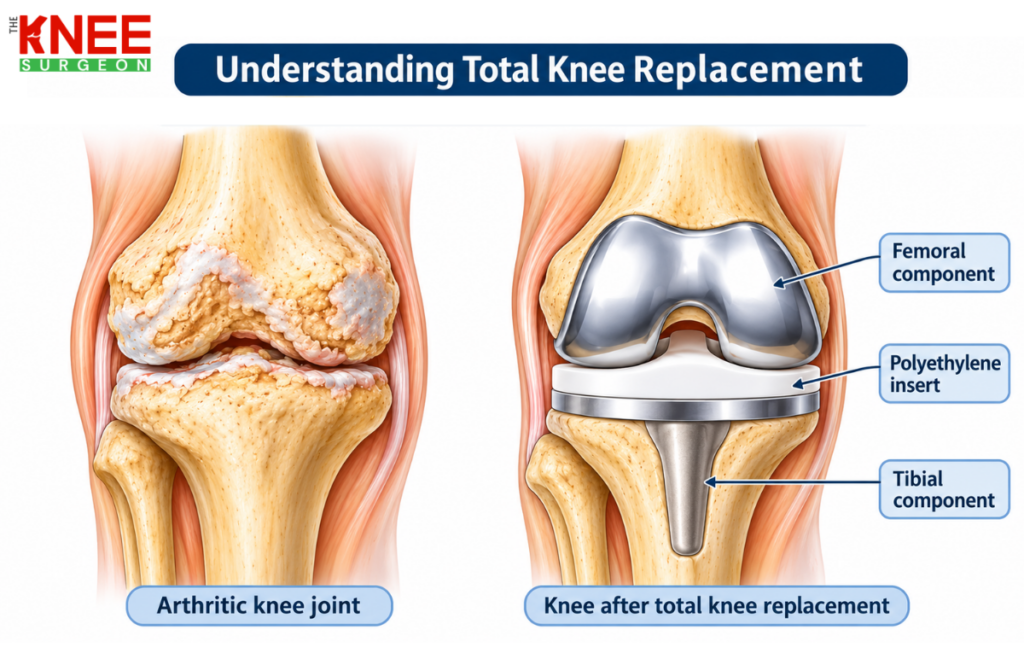
Total knee replacement involves removing damaged cartilage and a small amount of underlying bone from the affected joint surfaces and replacing them with artificial components.
The procedure generally involves resurfacing the lower end of the thigh bone and the upper end of the shin bone with metal components, with a medical-grade plastic insert placed between them to allow smooth movement.
A kneecap component may also be used in selected cases.
Total knee replacement is commonly considered when arthritis affects multiple areas of the knee joint and causes significant pain, stiffness and movement limitations.
Partial Knee Replacement
Partial knee replacement, also known as unicompartmental knee replacement, involves replacing only the damaged compartment of the knee rather than the entire joint.
The knee has three main compartments: the medial compartment, lateral compartment and patellofemoral compartment.
This procedure may be suitable when arthritis is restricted to one compartment and the remaining joint structures and supporting ligaments are in an appropriate condition.
The decision between partial and total knee replacement depends on the location of arthritis, ligament stability, knee movement and other examination findings.
Bilateral Knee Replacement
Bilateral knee replacement refers to replacing both knee joints. Depending on the patient’s condition, the procedures may be performed during the same operation or as separate surgeries.
Patients with advanced arthritis affecting both knees may discuss this option with their orthopaedic surgeon.
The decision depends on general health, medical fitness, severity of arthritis in each knee, anaesthesia considerations and the patient’s ability to participate in rehabilitation.
Performing both procedures together is not appropriate for everyone, and the risks and recovery requirements should be discussed before deciding.
Revision Knee Replacement
Revision knee replacement is a procedure performed when a previously replaced knee joint requires further surgery.
Reasons may include implant loosening, wear of the implant components, infection, instability, fracture around the implant or persistent problems affecting knee function.
Revision surgery can be more complex than an initial knee replacement because the surgeon may need to address bone loss, damaged surrounding structures or complications from the earlier procedure.
The surgical plan depends on the reason for revision and the condition of the existing implant and surrounding bone.
Robotic-Assisted Knee Replacement
Robotic-assisted knee replacement uses computer-based planning and a robotic-assisted system to help the surgeon plan and carry out selected parts of the procedure.
Depending on the system, preoperative imaging or information collected during surgery may help create a three-dimensional representation of the knee and assist with bone preparation and implant positioning.
The surgeon remains responsible for making clinical decisions and performing the operation. Robotic assistance does not independently perform the surgery.
Its suitability depends on the patient’s joint anatomy, type of arthritis, implant requirements, available technology and the surgeon’s assessment. It should not be assumed to be necessary or superior for every patient.
How to Choose a Knee Replacement Surgeon in Chennai?
Choosing an orthopaedic surgeon for knee replacement is an important decision. Patients may compare several knee replacement doctors in Chennai before deciding where to seek a consultation.
Rather than relying only on online descriptions or promotional claims, patients can consider the following points:
- Relevant qualifications: Check the surgeon’s recognised medical qualifications and orthopaedic training.
- Professional registration: Verify the doctor’s registration with the relevant medical council.
- Experience with the proposed procedure: Ask about the surgeon’s experience with the specific type of knee replacement being discussed.
- Explanation of treatment options: The surgeon should explain whether non-surgical treatment, partial replacement or total replacement may be appropriate.
- Understanding of risks: Ask about possible complications, expected limitations and factors that may affect recovery.
- Hospital facilities: Understand the availability of anaesthesia services, nursing care, rehabilitation and emergency support.
- Postoperative guidance: Discuss the physiotherapy plan, follow-up appointments and support required after discharge.
- Communication: Patients should feel comfortable asking questions and understanding the reasons behind the treatment recommendation.
A consultation with an orthopaedic surgeon should provide enough information for patients to understand their condition and make decisions with appropriate medical guidance.
Robotic-Assisted Knee Replacement: Planning and Suitability
Robotic-assisted knee replacement is one of the surgical approaches available for selected patients with advanced knee arthritis.
Before the procedure, the surgeon assesses the patient’s joint condition, bone alignment, movement and overall medical fitness. Depending on the robotic system being used, imaging or intraoperative measurements may be used to prepare a surgical plan.
During the operation, the technology provides information that can assist with bone preparation and implant positioning. The surgeon reviews this information and makes adjustments according to the patient’s anatomy and surgical requirements.
Patients considering robotic-assisted knee surgery should understand that the technology is an aid to the surgeon. It does not replace surgical judgement, clinical experience or postoperative rehabilitation.
Questions worth discussing during consultation include:
- Is robotic assistance appropriate for my knee condition?
- What type of robotic system is being used?
- Is additional imaging required before surgery?
- How does the proposed approach differ from conventional knee replacement?
- What are the limitations and additional considerations?
- What rehabilitation will be required after the procedure?
The final decision should be based on clinical suitability rather than the availability of technology alone.
How are Knee Implants Selected?
A knee implant is an artificial component used to replace damaged joint surfaces during knee replacement surgery.
Implant selection is an important part of surgical planning. The surgeon considers several factors before choosing the components.
These may include:
- The patient’s bone size and joint anatomy.
- The extent and location of cartilage and bone damage.
- The stability of the knee and condition of the surrounding ligaments.
- The type of replacement being performed.
- The patient’s age, activity level and general health.
- The implant design and fixation method suitable for the procedure.
Implants may consist of metal components and a medical-grade plastic bearing surface. Some designs use cemented fixation, while others may use cementless fixation depending on the bone condition and surgical requirements.
Patients can ask their surgeon about the implant design, expected functional limitations, follow-up requirements and factors that may affect implant longevity.
No single implant is appropriate for every patient. The selection should be based on individual anatomy and clinical needs.
How is Knee Replacement Surgery Performed?
Knee replacement surgery involves removing the damaged joint surfaces and placing artificial components to restore the joint’s structure and function.
The procedure generally includes the following stages:
1. Anaesthesia: The anaesthesia team evaluates the patient and determines the suitable anaesthesia approach based on medical history and surgical requirements. Spinal and general anaesthesia are among the options.
2. Surgical incision: The surgeon makes an incision to access the knee joint.
3. Preparation of the joint: Damaged cartilage and a measured amount of underlying bone are removed from the affected joint surfaces.
4. Implant positioning: The selected artificial components are positioned according to the surgical plan. The surgeon checks alignment, stability and movement.
5. Wound closure: After checking the joint and completing the required steps, the incision is closed and a dressing is applied.
6. Postoperative monitoring: The patient is shifted to the recovery area, where the medical team monitors vital signs, pain and recovery from anaesthesia.
The exact surgical technique, implant components and duration of the procedure vary according to the type of knee replacement and the patient’s condition.
Benefits, Risks and Limitations of Knee Replacement
Knee replacement is intended to reduce pain caused by damaged joint surfaces and improve the ability to perform everyday activities.
Possible benefits include:
- Reduced arthritis-related knee pain.
- Improved ability to walk and move around.
- Better performance of routine activities.
- Correction of certain knee deformities.
- Improved joint function and mobility.
However, knee replacement is a major surgical procedure, and patients should understand its potential risks and limitations.
Possible complications include:
- Infection around the wound or implant.
- Blood clots in the legs.
- Bleeding or wound-healing problems.
- Stiffness or restricted knee movement.
- Persistent pain or swelling.
- Injury to nearby nerves or blood vessels.
- Implant loosening, wear or instability.
- The possibility of further surgery in the future.
The procedure also has functional limitations. Patients may continue to experience some stiffness or discomfort, and activities involving repeated high-impact loading may not be recommended.
Knee replacement does not restore a completely natural knee. The expected improvement and limitations differ between individuals and should be discussed before surgery.
Preparing for Knee Replacement Surgery
Preparation before surgery helps the medical team understand the patient’s health and plan the procedure.
The preparation process may include:
Medical evaluation: Existing conditions such as diabetes, high blood pressure, heart disease and kidney problems should be discussed with the treating team.
Medication review: Inform the doctor about all prescribed medicines, over-the-counter drugs and supplements. Do not stop any medication without medical advice.
Preoperative investigations: Blood tests, ECG, imaging and other investigations may be requested depending on the patient’s health and anaesthesia assessment.
Physical preparation: The doctor or physiotherapist may recommend suitable exercises to improve strength and prepare the patient for postoperative movement.
Home arrangements: Patients may need temporary assistance with bathing, cooking, shopping and other activities during the initial recovery period.
Understanding the procedure: Discuss the surgical plan, expected hospital stay, rehabilitation requirements, potential complications and follow-up schedule.
paration also involves arranging transport and support for the journey home after hospital discharge.
What Happens During the Hospital Stay?
After knee replacement surgery, patients are monitored in the recovery area before being shifted to their hospital room, depending on their condition.
The hospital stay generally involves several stages:
- Monitoring: The medical team checks vital signs, pain levels, wound condition and recovery from anaesthesia.
- Pain management: Appropriate medicines are provided to help manage postoperative discomfort.
- Early movement: A physiotherapist may help the patient begin standing and walking with a walker or other support when medically appropriate.
- Wound care: The surgical dressing and incision are monitored for signs of bleeding or infection.
- Rehabilitation guidance: Patients receive instructions about exercises, movement and precautions.
- Discharge assessment: The medical team evaluates whether the patient can move safely, manage essential activities and continue recovery at home.
The duration of the hospital stay depends on the patient’s general health, type of surgery, recovery progress and hospital care plan.
Recovery After Knee Replacement Surgery
Recovery after knee replacement takes time and involves gradual improvement in movement, strength and confidence. The recovery period differs depending on the type of procedure, overall health, preoperative mobility and participation in rehabilitation.
Patients should follow the instructions provided by their surgeon and physiotherapist rather than comparing their recovery with someone else’s experience.
Initial Recovery
During the first few days, patients may experience pain, swelling and stiffness around the operated knee.
The medical team provides guidance on wound care, prescribed medicines, leg positioning and safe movement. Walking may begin with support once the patient is medically ready.
Swelling and discomfort can continue for some time, but their progression should be monitored.
Walking After Surgery
Walking is usually introduced early as part of the rehabilitation process.
Initially, patients may use a walker, crutches or another walking aid. The level of support is gradually adjusted as strength, balance and confidence improve.
The distance and duration of walking should be increased according to the physiotherapist’s instructions.
Physiotherapy and Exercises
Physiotherapy is an important part of recovery following knee replacement.
The exercises may focus on:
- Improving knee bending and straightening.
- Strengthening the thigh and surrounding muscles.
- Improving balance and coordination.
- Developing a safe walking pattern.
- Gradually increasing functional movement.
Patients should perform the recommended exercises regularly while avoiding activities that cause excessive discomfort or are not permitted by the treating team.
Returning to Daily Activities
Returning to routine activities happens gradually.
Patients may need assistance with bathing, dressing, household work and travelling during the initial stages. Activities such as climbing stairs, driving and returning to work depend on recovery progress and the nature of the activity.
The surgeon and physiotherapist should guide patients on when these activities can be resumed safely.
Follow-Up Visits
Follow-up appointments allow the surgeon to evaluate wound healing, knee movement, pain, stability and overall progress.
X-rays may be requested to assess implant positioning and the condition of the joint.
Patients should attend scheduled appointments even when they feel that recovery is progressing well.
When to Seek Medical Advice
Patients should contact their treating medical team if they notice:
- Increasing pain or swelling rather than gradual improvement.
- Persistent fever or chills.
- Redness, warmth or discharge around the surgical wound.
- Increasing calf pain, tenderness or swelling.
- New difficulty moving or putting weight on the operated leg.
Sudden chest pain, breathing difficulty or fainting requires emergency medical attention because these may indicate a serious complication such as a blood clot.
Factors That Affect Knee Replacement Surgery Cost in Chennai
The cost of knee replacement surgery in Chennai can differ between hospitals and patients. It is influenced by several medical and hospital-related factors.
Some important considerations include:
Type of surgery: Total, partial, bilateral and revision knee replacement involve different surgical requirements.
Implant selection: Implant design, materials and fixation methods may influence the overall expense.
Robotic assistance: When robotic-assisted surgery is used, technology-related charges and additional planning requirements may affect the cost.
Hospital facilities: Room category, operating theatre facilities, nursing care and hospital services contribute to the overall expense.
Medical investigations: Preoperative blood tests, imaging, cardiac evaluation and other assessments may be included.
Duration of hospital stay: The length of admission and any additional medical care required can change the final amount.
Rehabilitation: Physiotherapy, medicines, follow-up appointments and rehabilitation services may add to the overall treatment expenditure.
Patients should request a written estimate that explains what is included and whether additional expenses may arise. The final cost should be discussed with the hospital after the procedure and medical requirements have been assessed.
Consultation Locations in Chennai
Patients looking for an orthopaedic consultation in Chennai should confirm the available consultation location, appointment timings and hospital arrangements before visiting.
Dr. Vijay Kumar Sohanlal is associated with orthopaedic services at MAHI Multispecialty Hospitals, Kilpauk.
The consultation location and availability may vary according to the doctor’s schedule. Patients should confirm the current appointment arrangements directly with the relevant hospital.
Making an Informed Decision About Knee Replacement
Living with persistent knee pain can affect independence, movement and everyday comfort. However, deciding to undergo knee replacement requires more than identifying arthritis on an X-ray or comparing surgical techniques.
Patients should understand the cause of their symptoms, the extent of joint damage, the available treatment options and the possible outcomes of each approach.
A discussion with an orthopaedic surgeon can help clarify whether non-surgical management should continue or whether partial or total knee replacement may be appropriate.
It is equally important to understand the risks, implant requirements, hospital arrangements and rehabilitation involved after surgery. Having these discussions before making a decision helps patients approach treatment with realistic expectations and a clearer understanding of their care.
Read more: Knee Ligament Surgery