

Knee pain rarely begins as a medical emergency. It starts subtly, often ignored in the beginning. A mild stiffness while waking up, a slight discomfort while climbing stairs, or a short pause before walking longer distances slowly becomes part of daily life.
Over time, this changes how a person lives. Movements that were once effortless start requiring planning. Many patients begin adjusting their lifestyle without realizing it, choosing shorter walks, avoiding stairs, or relying more on support from family members. This is the gradual impact of knee osteoarthritis, where cartilage wears down and the smooth mechanics of the joint begin to fail.
When medications, physiotherapy, and injections no longer provide lasting relief, Total Knee Replacement (TKR) offers a reliable solution to improve mobility, restore joint function, and relieve persistent knee pain.
Today, two surgical pathways are commonly used: traditional knee replacement and robotic assisted knee replacement. Both aim for the same outcome, but they differ significantly in planning, execution, and precision methodology. Many patients researching robotic knee replacement vs. regular knee replacement want to understand this difference clearly before making a decision, and this guide breaks down robotic vs traditional knee replacement in simple, practical terms that are easy to follow even without a medical background.
What Knee Replacement Actually Means
Knee replacement is a reconstructive procedure that restores a damaged weight bearing joint. A healthy knee depends on proper alignment, smooth cartilage surfaces, balanced ligaments, and even load distribution. When osteoarthritis develops, these systems gradually collapse, leading to pain, stiffness, and instability.
The goal of knee replacement surgery is not to recreate the original joint but to rebuild a functional mechanical system that restores movement and stability. Damaged bone and cartilage are removed, alignment is corrected, and a prosthetic implant is placed to allow smooth motion. Understanding the difference between traditional and robotic knee replacement starts with understanding this shared clinical goal, since both pathways work toward the exact same outcome through different routes.
Expert Insight: Knee replacement replaces function, not biology. The aim is to restore movement, not replicate the original joint exactly.
Traditional Knee Replacement
Traditional knee replacement is one of the most widely performed orthopedic procedures in the world. It is built on decades of surgical refinement and remains highly effective in restoring mobility.
In this technique, the surgeon evaluates X rays, deformity patterns, and bone quality before surgery. During the procedure, the knee is opened, and damaged bone and cartilage are removed. Bone cutting is guided using mechanical alignment tools, and the surgeon relies on anatomical landmarks along with intraoperative judgment to ensure correct implant positioning.
Trial implants are inserted to check stability, alignment, and range of motion. Adjustments are made manually if needed before the final prosthesis is fixed. The accuracy of the procedure depends heavily on the surgeon’s experience, tactile feedback, and real time decision making.
This method remains highly reliable, especially in standard osteoarthritis cases. Its long term outcomes are well documented, and it continues to be widely used across healthcare systems globally.
Expert Insight: Traditional surgery is experience driven precision, where the surgeon’s skill plays the central role in achieving alignment and balance.
Robotic-Assisted Knee Replacement
Robotic knee replacement enhances surgical precision by integrating imaging technology and computer assisted planning into the procedure. It begins with a CT scan that creates a detailed 3D model of the patient’s knee joint. This digital model allows surgeons to understand deformities and plan implant positioning before entering the operating room.
During surgery, a robotic guidance system assists in executing bone cuts with high accuracy. The system restricts movements within predefined boundaries, ensuring that bone resection follows the planned design. However, the surgeon remains fully in control throughout the procedure.
Implant placement is guided by this digital planning, allowing for more precise alignment and potentially better joint balance in complex deformities. The final positioning is verified both digitally and manually before completing the surgery.
Expert Insight: Robotics does not perform surgery, it refines precision by translating preoperative planning into controlled execution.
Key Clinical Differences – Robotic vs Traditional Knee Replacement
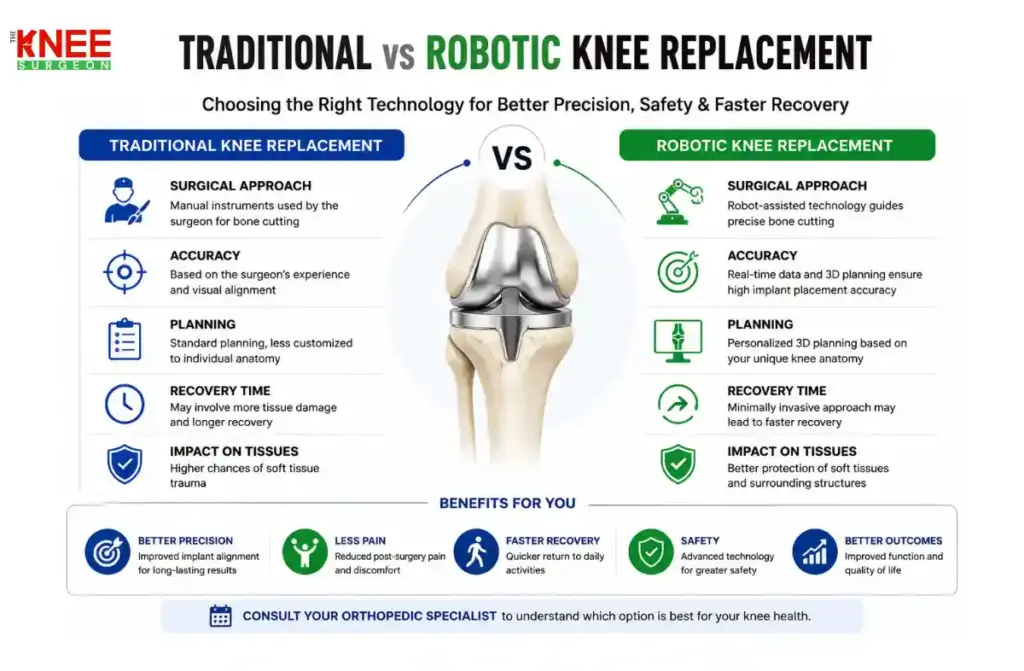
To understand traditional vs robotic assisted knee replacement surgery in practical terms, it helps to compare how each approach plans and executes the procedure:
| Clinical Aspect | Traditional Knee Replacement | Robotic-Assisted Knee Replacement |
| Core Principle of Precision | Precision is achieved mainly during surgery through surgeon experience, anatomical landmarks, and real-time judgment | Precision is largely pre-planned before surgery using CT-based 3D modeling and digital simulation |
| Planning Approach | Relies on X-rays and intraoperative assessment; final decisions refined during surgery | Uses detailed 3D reconstruction of the knee for pre-surgical planning of alignment and implant positioning |
| Execution Method | Surgeon manually performs bone cuts using mechanical guides and intraoperative feedback | Robotic guidance assists in executing pre-defined bone cuts with controlled accuracy |
| Intraoperative Flexibility | High flexibility; surgeon can adjust alignment instantly based on real-time findings | More controlled and structured; adjustments are limited to within planned robotic boundaries |
| Handling Anatomical Variations | Highly dependent on surgeon experience in managing unexpected variations | Improved predictability due to pre-mapped anatomy and digital visualization |
| Alignment Strategy | Based on mechanical axis principles and surgeon interpretation | Based on patient-specific 3D anatomical alignment planning |
| Consistency of Outcomes | Strong but can vary slightly with surgeon skill and case complexity | More consistent due to standardized robotic precision control |
| Philosophy of Surgery | Experience-driven, adaptive, and real-time decision-oriented approach | Technology-assisted, pre-planned, and precision-controlled execution approach |
Core Clinical Insight: Traditional knee replacement achieves precision through intraoperative surgical judgment, while robotic knee replacement achieves precision through preoperative digital planning and controlled execution. This is the essence of robotic vs traditional knee replacement when reduced to its simplest form.
Early Recovery
Recovery after knee replacement is not just healing of tissues, it is the body and mind learning to trust movement again. While surgery corrects the damaged joint mechanically, early recovery is where function is truly rebuilt through pain control, physiotherapy, and psychological adaptation.
Patients often notice something unexpected: the old arthritis pain is gone, but movement still feels unfamiliar. This is normal. The brain is adjusting to a new joint system, and the muscles are relearning coordination.
0 to 2 Weeks
This is the most sensitive phase, where healing and hesitation coexist.
Pain and swelling are expected and represent normal post surgical inflammation. However, this pain is different from arthritis, it is temporary and healing related. Within 24 to 48 hours, patients are encouraged to stand and take assisted steps, usually with support devices.
Movement feels slow and cautious. The knee may feel “foreign,” not because something is wrong, but because the body is still adapting to the implant. Physiotherapy begins early with gentle bending and straightening to prevent stiffness and activate circulation.
Clinical Insight: This phase is not about strength, it is about re establishing safe movement patterns.
2 to 6 Weeks
In this phase, recovery becomes visible in daily life. Pain gradually reduces and no longer dominates awareness. Walking becomes more stable, and support devices are reduced step by step.
Physiotherapy plays a central role in restoring range of motion and rebuilding quadriceps strength. Stiffness reduces, and patients begin performing basic daily activities with increasing independence.
Emotionally, this is a turning point. Fear of movement slowly replaces itself with confidence.
6 to 12 Weeks
By this stage, movement starts feeling natural again. Walking becomes smoother, stair climbing improves, and daily independence is largely restored.
Muscle strength and endurance continue to rebuild, but the most important change is psychological, patients begin to stop “thinking about the knee” during movement. The joint transitions from being a medical concern to becoming part of normal life again.
Clinical Insight: Recovery is no longer about surgery, it becomes about lifestyle restoration.
Robotic vs Traditional Recovery
Robotic knee replacement may offer slightly smoother early movement due to more precise alignment and joint balancing. However, traditional knee replacement follows a steady, predictable recovery pattern with equally strong long term results. This subtle contrast is often the deciding factor patients weigh when comparing robotic knee replacement vs. regular knee replacement during their recovery planning.
Final Insight
Early recovery is where surgical correction becomes a real life function. It is a combination of healing tissue, retraining muscles, and rebuilding confidence. When guided properly, this phase transforms a patient from limited movement to restored independence, step by step, naturally and sustainably.
Cost and Accessibility
Cost and accessibility are often the most decisive practical factors for patients, especially when both surgical options offer strong clinical outcomes. However, understanding why the cost differs and how accessibility varies helps patients make a more informed and realistic decision rather than a purely financial one.
Robotic Knee Replacement – Cost Structure and Accessibility
Robotic knee replacement is positioned as an advanced surgical option because it integrates digital planning systems, imaging technology, and robotic-assisted execution tools into the operating workflow. This naturally increases overall procedural cost.
- Higher cost due to advanced infrastructure
- Requires robotic surgical systems and navigation platforms
- Involves CT-based 3D imaging and preoperative digital planning software
- Uses specialized disposable instruments and calibrated robotic attachments
- Higher maintenance and operational costs for hospital infrastructure
- Limited availability in healthcare settings
- Primarily available in tertiary care and super-specialty orthopedic centers
- Requires trained surgical teams familiar with robotic systems
- Not commonly present in smaller hospitals or semi-urban setups
- Concentrated mostly in high-volume orthopedic institutions
- Insurance and financial considerations
- Coverage varies significantly across insurance providers and policies
- In many cases, robotic component costs may be partially out-of-pocket
- Patients may need pre-authorization depending on hospital policy structure
- Patient selection trend
- Often chosen by patients seeking precision-focused or advanced surgical planning
- More commonly selected in elective, non-emergency cases with planned procedures
Clinical Insight: Robotic surgery cost reflects technology infrastructure rather than a difference in surgical necessity or baseline clinical effectiveness.
Traditional Knee Replacement – Cost Structure and Accessibility
Traditional knee replacement remains the most widely performed orthopedic joint replacement procedure globally due to its efficiency, simplicity, and minimal dependence on advanced technology systems.
- More cost-effective surgical model
- Does not require robotic platforms or CT-based planning systems
- Uses standard mechanical surgical instruments
- Lower infrastructure and operational cost for hospitals
- Reduces overall procedural expense for patients
- Widespread availability across healthcare levels
- Available in most secondary and tertiary hospitals
- Performed routinely in both urban and rural healthcare settings
- Does not require highly specialized robotic training systems
- Easily accessible in emergency and elective orthopedic care pathways
- Insurance-friendly procedure
- More consistently covered under standard health insurance policies
- Lower chances of additional out-of-pocket technological charges
- Preferred option in government and reimbursement-based healthcare systems
- High clinical efficiency despite simplicity
- Strong long-term outcomes supported by decades of surgical data
- Highly effective in standard osteoarthritis and routine deformity cases
- Relies more on surgical expertise than technological dependency
Clinical Insight: Traditional knee replacement remains the backbone of global joint replacement programs due to its balance of affordability, accessibility, and proven reliability.
Balanced Clinical Perspective – What Truly Matters
While cost and accessibility differ significantly between the two approaches, it is important to understand that financial investment does not directly determine surgical success.
Both robotic and traditional knee replacements aim to achieve identical clinical goals:
- Pain relief
- Correct alignment
- Restored mobility
- Improved quality of life
Long-term outcomes depend more on:
- Surgeon experience and precision
- Patient rehabilitation discipline
- Bone quality and joint condition
- Proper implant positioning
Expert Insight: Cost defines the pathway of care, not the quality of outcome. When performed correctly, both approaches can deliver equally strong functional recovery and long-term success.
Clinical Decision-Making – How the Choice Is Actually Made
The decision between robotic and traditional knee replacement is never based on technology alone. It is based on patient-specific clinical evaluation.
Surgeons consider several important factors such as the severity of deformity, bone quality, ligament stability, and overall joint condition. Patient age, activity level, and expectations also play an important role. In addition, financial considerations and hospital availability influence the final decision.
In cases with standard anatomy and straightforward osteoarthritis, both techniques perform equally well. In more complex deformities, robotic assistance may offer additional precision benefits. However, traditional surgery remains highly effective when performed by experienced surgeons.
Expert Insight: The best surgical option is the one that matches the patient’s anatomy, not the one that appears technologically superior.
Risks and Clinical Realities – A Transparent Understanding
Both robotic and traditional knee replacement share similar medical risks because the biological healing process remains the same regardless of surgical technique.
Infection is rare but possible and is managed through sterile protocols and antibiotics. Blood clots can occur due to reduced mobility but are effectively prevented through medication and early movement. Joint stiffness is one of the most common concerns and is strongly linked to physiotherapy adherence.
Some patients may experience pain and swelling during early recovery, which gradually reduces over time. Implant wear is a long term possibility influenced by activity levels and biomechanics rather than surgical method. This is an important reminder that robotic vs traditional knee replacement does not change the underlying biology of healing.
Clinical Reality: Surgery corrects alignment, but healing outcomes are determined by biology and rehabilitation.
Benefits
| Factor | Robotic Knee Replacement | Traditional Knee Replacement |
| Alignment Precision | High-precision 3D guided alignment | Surgeon-guided mechanical alignment |
| Surgical Planning | Digital preoperative simulation | X-ray based planning |
| Early Recovery Feel | Often smoother and more confident | Steady and predictable recovery |
| Complexity Handling | Strong advantage in deformities | Highly dependent on surgeon expertise |
| Cost | Higher | More affordable |
| Accessibility | Limited centers | Widely available |
| Long-term Outcomes | Comparable | Comparable |
| Dependence | Technology-assisted precision | Surgeon-driven execution |
Meet the Expert Behind Precision Knee Care
Choosing between robotic and traditional knee replacement is easier when guided by a surgeon who is experienced in both approaches. Dr. Vijay Kumar Sohanlal is a trusted orthopaedic and joint replacement surgeon in Chennai with over 18+ years of experience in knee and hip replacement, including advanced robotic and navigation-assisted techniques. He has trained internationally, with fellowships in Germany and Australia, and previously served as Clinical Lead for Robotic Joint Replacement at leading hospitals before founding MAHI Multispecialty Hospital in Kilpauk, Chennai.
Dr. Vijay Sohanlal’s approach is rooted in matching the surgical technique to the patient’s anatomy rather than technology alone, evaluating deformity severity, bone quality, ligament stability, and lifestyle expectations before recommending robotic knee replacement vs. regular knee replacement.
Conclusion
Robotic and traditional knee replacement are not competing techniques. They are two clinically validated pathways that lead to the same destination: restored mobility and reduced pain. Robotic surgery represents the evolution of precision through digital planning and controlled execution. Traditional surgery represents the strength of surgical experience built over decades of clinical practice.
However, the most important factor remains unchanged across both approaches: the success of surgery depends on the right combination of patient selection, surgical expertise, and rehabilitation commitment. When these elements align, knee replacement becomes more than a medical procedure—it becomes a return to independence, confidence, and unrestricted movement.