

Medically reviewed by: Dr. Vijay Kumar Sohanlal, MBBS, MS (Orthopaedics), Orthopaedic and Joint Replacement Surgeon, Founder and Owner, MAHI Multispecialty Hospital, Kilpauk, Chennai
Last medically reviewed: October 2026
Hip pain can make walking, climbing stairs, sitting comfortably and sleeping more difficult. When these problems persist, it is important to understand what is causing them and which treatments may be appropriate.
Hip replacement is one option for certain conditions that damage the hip joint. This guide explains when the procedure may be considered, how it is performed, what recovery involves and what patients should discuss with their orthopaedic doctor.
What is Hip Replacement Surgery?
Hip replacement surgery involves replacing damaged parts of the hip joint with artificial components called prostheses. The hip is a ball-and-socket joint: the rounded head of the thighbone fits into a socket in the pelvis. Cartilage covering these surfaces allows the joint to move smoothly.
When cartilage and underlying bone become damaged, movement can cause pain and stiffness. If the damage is advanced, the symptoms may interfere with daily activities.
The type of replacement depends on the condition being treated. In a total hip replacement, both the femoral head and the socket are replaced. In a partial hip replacement, the femoral head is replaced while the natural socket is retained. The appropriate procedure depends on the diagnosis and the patient’s clinical circumstances.
When is Hip Replacement Considered?
Hip replacement may be considered when joint damage causes persistent pain or limits everyday activities, particularly when suitable non-surgical treatments have not provided enough relief.
Conditions that may lead to consideration of surgery include:
- Osteoarthritis: Progressive damage to the cartilage in the joint.
- Avascular necrosis: Damage to bone tissue caused by reduced blood supply, which can lead to collapse of the femoral head.
- Rheumatoid arthritis: Inflammation that can damage the hip joint.
- Certain hip fractures: Some fractures, particularly in older adults, may be treated with partial or total replacement.
- Post-traumatic arthritis: Joint damage that develops following an injury or fracture.
Not everyone with hip pain needs surgery. Depending on the cause and severity, treatment may include medication, physiotherapy, activity modification, walking aids or other appropriate measures. An examination and relevant imaging help establish whether replacement should be considered.
What are the Different Types of Hip Replacement?
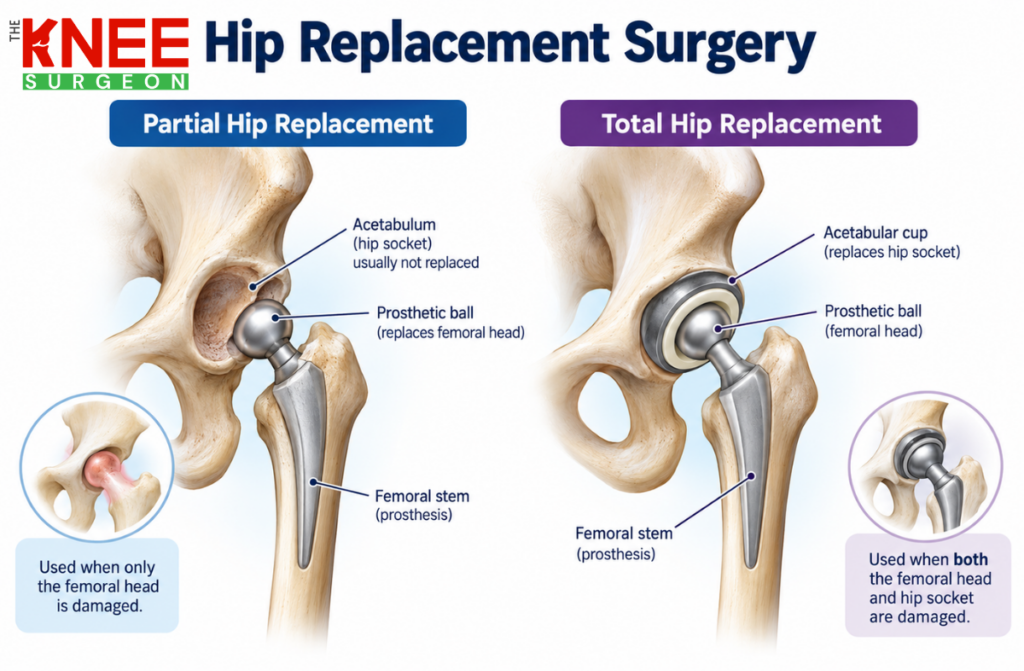
Total hip replacement
In total hip replacement, the damaged femoral head is removed and the socket is prepared to receive an artificial component. A stem is placed in the thighbone, with a prosthetic head attached to it. The materials and method of fixation are selected according to the patient’s anatomy, bone quality and other clinical considerations.
Partial hip replacement
Partial hip replacement involves replacing the femoral head while retaining the natural socket. It is used in selected circumstances, including certain hip fractures. It is not suitable for every patient with hip pain or arthritis.
Revision hip replacement
Revision surgery involves removing, replacing or repairing components of an existing hip implant. It may be considered when an implant becomes loose, wears out, becomes infected or develops another significant complication. The assessment and planning may be more complex than for an initial replacement.
Robotic-assisted and computer-assisted techniques
Some hip replacement procedures use computer-assisted planning or robotic technology to help the surgical team plan and execute particular steps. These systems do not independently perform the operation. Their use depends on the patient’s needs, the equipment available and the surgeon’s clinical assessment. Technology does not eliminate surgical risks or guarantee a particular outcome.
How is Hip Replacement Surgery Performed?
The process usually includes preoperative assessment, surgery and postoperative rehabilitation.
Before surgery
The doctor reviews the patient’s symptoms, medical history, current medication and previous treatments. A physical examination and X-rays help assess the joint. Blood tests, cardiac assessment or other investigations may be required depending on the patient’s health.
Patients should tell their clinical team about existing medical conditions, allergies, previous operations and all medicines they take, including supplements and blood-thinning medication.
During surgery
The procedure is performed under an appropriate anaesthetic, commonly spinal or general anaesthesia. The damaged joint surfaces are replaced with the selected artificial components. The surgical approach and implant fixation depend on the patient’s anatomy, diagnosis and other relevant factors.
The operating team monitors the patient throughout the procedure and plans postoperative care according to the individual’s condition.
After surgery
Pain management, wound care, mobilisation and rehabilitation are important parts of recovery. When clinically appropriate, patients begin standing or walking with assistance. A physiotherapist may teach exercises and safe ways to move, sit, stand and use stairs.
The treating team provides instructions on medication, wound care, walking aids, follow-up visits and activities that should be limited during recovery.
How Long Does Recovery Take After Hip Replacement?
Recovery differs from one person to another. Age, general health, muscle strength, bone quality, the type of surgery and progress with rehabilitation can all influence the timeline.
Some patients resume many routine activities within several weeks, while others need longer. Strength, balance and confidence may continue to improve over several months.
Patients should follow their own rehabilitation plan rather than compare their progress with someone else’s. Driving, returning to work, lifting objects and resuming exercise should be discussed with the treating team.
Movement precautions also vary according to the surgical approach and individual risk factors. Not every patient needs the same restrictions, so the instructions given by the treating team should take priority over general advice found online.
What are the Risks of Hip Replacement?
Hip replacement is a major operation and, like other surgeries, carries potential risks. These may include:
- Infection around the wound or implant
- Blood clots in the legs or lungs
- Dislocation of the artificial joint
- Bleeding or injury to nearby nerves or blood vessels
- Differences in leg length
- Persistent pain or stiffness
- Wear, loosening or failure of implant components
- The possible need for further surgery
The likelihood of complications varies according to the patient’s health, the condition being treated and other clinical factors. Preoperative assessment and appropriate postoperative care help the team identify and manage relevant risks, but cannot remove them entirely.
Sudden breathlessness, chest pain, significant calf swelling, fever with wound problems or sudden severe pain around the operated hip requires prompt medical assessment.
How Long Can a Hip Replacement Implant Last?
Hip implants can function for many years, but their lifespan varies. Implant design, bone health, activity level, body weight, fixation and other factors influence how the joint performs over time.
Some patients may eventually need revision surgery because of wear, loosening, infection or another complication. Patients should ask about the expected performance of the proposed implant, the importance of follow-up and any activity recommendations relevant to their circumstances.
Preparing for a Consultation
A consultation is an opportunity to understand the diagnosis, compare treatment options and discuss whether surgery is appropriate. Patients may find it helpful to ask:
- What is causing my hip pain?
- Are non-surgical treatments suitable for my condition?
- Why might hip replacement be appropriate in my case?
- What benefits and risks should I consider?
- Which type of replacement and implant are being proposed?
- What support will I need at home after surgery?
- What rehabilitation and follow-up will be required?
The decision to proceed should follow an informed discussion of the likely benefits, possible complications, alternatives and the patient’s preferences.
About Dr. Vijay Kumar Sohanlal
Dr. Vijay Kumar Sohanlal is an orthopaedic and joint replacement surgeon practising in Chennai. His listed qualifications include an MBBS from Mysore University and an MS in Orthopaedics from Sri Ramachandra Medical College, Chennai.
His professional biography also lists fellowship training in joint replacement surgery at Breach Candy and Lilavati Hospital in Mumbai, advanced joint arthroplasty training at St. Josef Bruderkrankenhaus Hospital in Germany, and further training in joint replacement and arthroscopy at Sportsmed Hospital in Australia.
His clinical work includes hip and knee joint replacement. His listed professional appointments include MAHI Multispeciality Hospital in Kilpauk and MGM Healthcare in Chennai. Patients can verify his current registration details and discuss his relevant training, the proposed procedure and postoperative follow-up during a clinical consultation.