

Medically reviewed by: Dr. Vijay Kumar Sohanlal, MBBS, MS (Orthopaedics), Orthopaedic and Joint Replacement Surgeon, Founder and Owner, MAHI Multispecialty Hospital, Kilpauk, Chennai
Last medically reviewed: September 2026
Hip pain has a way of quietly taking over daily life. Getting up from a chair, walking to the kitchen, or climbing a few stairs can start to feel like a task rather than something automatic. When the joint has worn down enough that rest, medication, and physiotherapy no longer offer relief, hip replacement surgery becomes the option that actually restores movement. Finding the right hip replacement surgeon in Kilpauk matters at this stage, since the outcome depends heavily on how the surgery is planned and carried out.
What Hip Replacement Surgery Actually Involves
Hip replacement surgery removes the damaged parts of the joint and replaces them with an artificial implant designed to move the way a healthy hip does. It is generally recommended for advanced arthritis, hip fractures, or joint degeneration that has not responded to conservative treatment. A qualified hip replacement surgeon in Kilpauk evaluates the joint through imaging and a physical assessment before recommending the surgical approach suited to the patient’s condition.
Types of Hip Replacement Surgery
Not every patient needs the same procedure, and understanding the options helps set realistic expectations before surgery.
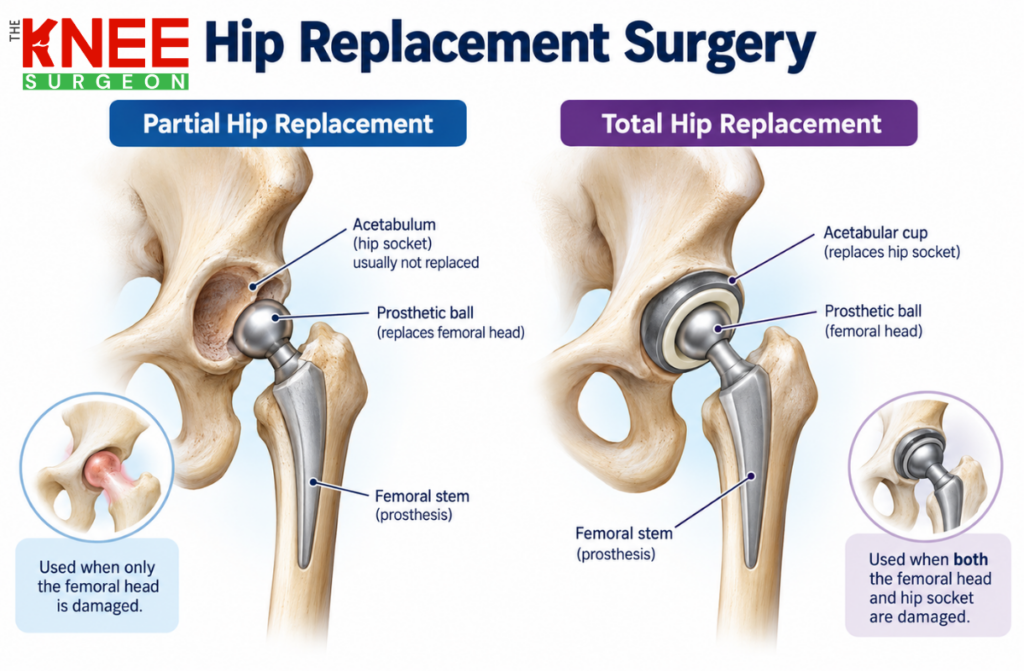
- Total hip replacement involves replacing the entire joint, including both the femoral head and the socket. It is the most common approach for advanced arthritis or significant joint damage.
- Partial hip replacement, also called hemiarthroplasty, replaces only the femoral head while preserving the natural socket. It is often used for certain hip fractures, particularly in older patients.
- Robotic assisted hip replacement uses robotic guidance to help the surgeon position the implant with greater precision, which can support better alignment and a smoother recovery.
- Revision hip replacement addresses a previous implant that has worn out, loosened, or failed, replacing or repairing the existing joint.
- Minimally invasive hip replacement uses smaller incisions and refined surgical techniques to reduce muscle disruption, post operative pain, and overall recovery time compared to traditional surgery.
Choosing an Experienced Surgeon
Choosing an experienced hip replacement surgeon in Kilpauk plays a vital role in restoring mobility and improving quality of life. Expertise, precision, and patient focused care are the key factors that shape a successful outcome.
Dr. Vijay Kumar Sohanlal
Dr. Vijay Kumar Sohanlal is widely recognized for his leadership in advanced hip joint replacement care, offering both robotic and non robotic techniques to deliver precise and dependable results. His expertise also extends to robotic and navigation assisted knee replacement and comprehensive trauma care, where timely intervention is essential for restoring movement and function. His continuous pursuit of innovation and global practices ensures patients receive safe, modern orthopedic solutions.
- Experience: 18+ years
- Qualifications: MBBS, MS (Orthopaedics)
- Hospital: MGM Healthcare, MAHI Hospitals, Kilpauk

Patient First Approach to Orthopedic Care
As a trusted hip replacement surgeon in Kilpauk, Dr. Vijay Sohanlal emphasizes accessibility, affordability, and personalized treatment. His focus on ethical practices, cost effective solutions for arthritis, and a patient friendly environment supports long term recovery and overall well being.
How to Choose the Right Hip Replacement Surgeon in Kilpauk
Selecting the right hip replacement surgeon in Kilpauk requires careful consideration of expertise, facilities, and patient outcomes.
- Expert Orthopedic Surgeons: Look for surgeons with extensive experience in hip replacement and advanced surgical techniques, including complex revision cases.
- Advanced Medical Facilities: Well equipped hospitals with modern imaging and surgical technology ensure precision and safety.
- Cost Effective Treatment: Transparent pricing and affordable care make high quality treatment accessible without compromising outcomes.
- Services for International Patients: Many centers offer dedicated care coordination for overseas patients, ensuring a smooth treatment journey.
What to Look for When Choosing a Surgeon
A few practical factors are worth weighing carefully. Look for meaningful experience with hip replacement procedures, including both standard and complex cases. Check whether the surgeon works with well equipped hospitals that have modern imaging and surgical technology, since this affects both precision and safety. Ask about pricing upfront, so there are no surprises once treatment begins. And if the surgeon or the associated clinic supports coordination for patients travelling from outside the city, that can make the entire treatment journey considerably smoother.
Benefits Patients Can Expect
Under the guidance of an experienced hip replacement surgeon in Kilpauk, most patients notice meaningful improvement well before full recovery is complete. Chronic hip pain is significantly reduced, which alone changes how comfortable everyday movement feels. Walking, climbing stairs, and standing for longer periods become manageable again. Modern implants are built to last, offering durable joint function for years. Advanced surgical techniques also tend to shorten recovery time and support earlier mobilisation after surgery, helping patients return to their normal routines sooner.
Advanced Techniques Used in Modern Hip Replacement
Surgical technique has a direct impact on how smoothly recovery goes. Robotic assisted surgery improves the accuracy of implant placement, which supports better alignment and long term joint durability. Minimally invasive approaches use smaller incisions, which generally means less pain, reduced blood loss, and a faster path back to normal activity. Keyhole techniques, or arthroscopy, are used for certain hip conditions where diagnosis and treatment can be handled with minimal disruption to surrounding tissue. Detailed pre-surgical planning, including three dimensional imaging, also improves accuracy during the procedure itself.
Recovery After Hip Replacement Surgery
Recovery timelines vary from patient to patient, but there are a few general patterns worth knowing.
In the early recovery period, patients are usually advised to avoid bending the hip beyond ninety degrees to reduce the risk of dislocation. This means avoiding low chairs, deep bending, and crossing the legs for a defined period after surgery. A hip replacement surgeon in Kilpauk will explain exactly how long this precaution needs to be followed based on the individual case.
Most patients begin climbing stairs with support within a few days of surgery, guided by a physiotherapist who teaches safe technique before discharge. Progress after that point depends on strength, balance, and how consistently prescribed exercises are followed.
The surgery itself typically takes between one and two hours, though the exact duration depends on the extent of joint damage, the surgical approach used, and whether advanced techniques are involved. Additional time is usually needed for anesthesia preparation and post surgical monitoring.
Where Hip Replacement is Headed
Robotic assisted and minimally invasive techniques represent the current direction of hip replacement surgery, offering more precise implant placement, smaller incisions, and generally faster recovery. For patients in earlier stages of joint damage, options such as joint preserving procedures, injections, or physical therapy may delay the need for surgery, though replacement remains the most reliable long term solution once joint damage becomes advanced. A thorough evaluation by a hip replacement surgeon in Kilpauk helps determine which path is appropriate for a given patient’s stage of joint deterioration.
Conclusion
Hip replacement surgery offers a genuine path back to comfortable, independent movement for patients whose joint pain has stopped responding to other treatments. The outcome depends on accurate diagnosis, a surgical approach suited to the individual, and careful post operative guidance through recovery. For anyone weighing this decision, consulting an experienced hip replacement surgeon in Kilpauk is the right starting point, since a clear understanding of the condition and the available surgical options makes it far easier to move forward with confidence.