Knee pain treatment without surgery is now a real and proven option for thousands of people every year. You do not need an incision or months of recovery to find real relief from knee pain. Whether you are dealing with morning stiffness, a sports injury, or years of chronic pain, there are effective treatments available. Most people with knee pain do not need surgery to live a pain free life. With the right diagnosis and the right specialist, lasting relief is absolutely possible. Dr. Vijay Kumar Sohanlal at MAHI Multispecialty Hospital in Chennai offers advanced non surgical treatments tailored to your condition. Before you consider the operating table, let us help you explore every option available to you.
Why Do Knees Hurt?
Your knee is doing an enormous amount of work every single day. It bends, absorbs impact, supports your weight, and keeps you moving. So when something goes wrong inside that joint, even something small, you feel it in everything you do.
Knee pain doesn’t always have one neat explanation. Most of the time, it comes from a combination of things building up over time.
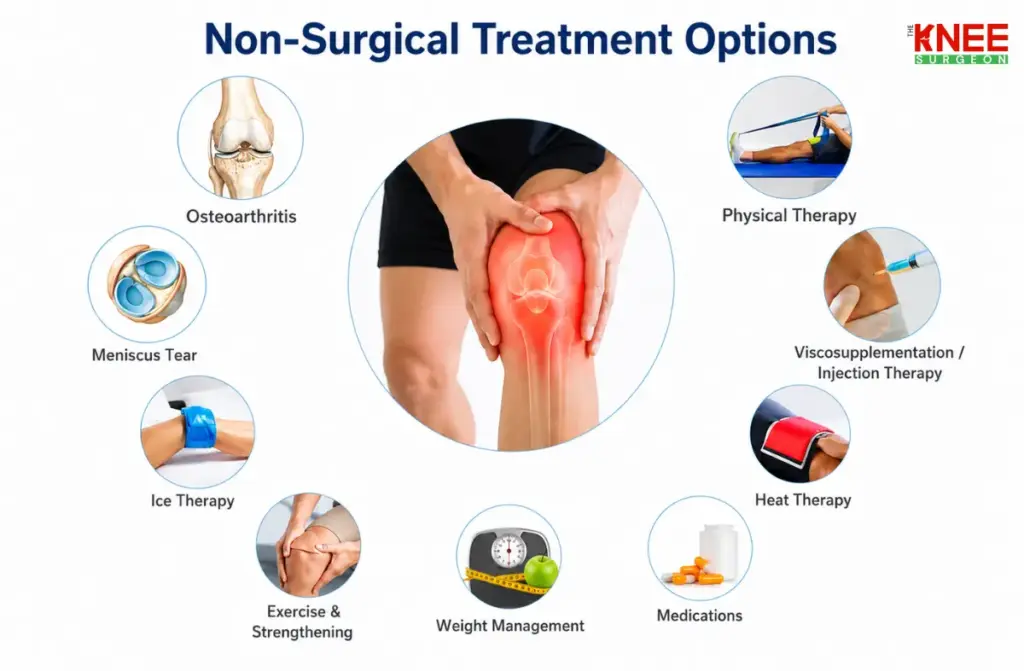
- Osteoarthritis is the most common reason people over 40 start noticing persistent knee pain. The cartilage that cushions the joint slowly wears away, and what’s left behind is stiffness, swelling, and that deep, grinding ache that gets worse by the end of the day.
- Ligament injuries such as tears to the ACL, MCL, or other connecting tissues are common in people who play sports or have had a sudden fall or twist. Even a partial tear can throw off your entire knee’s stability.
- Meniscus damage happens when the cartilage pads inside your knee get torn or worn down. This can cause sharp pain, locking, or the unsettling feeling that your knee is about to give out.
- Patellar tracking disorder is when your kneecap doesn’t move quite the way it should. It sounds minor, but it can cause persistent pain at the front of the knee that flares up every time you climb stairs or sit for long periods.
- Overuse injuries are what happen when you push your body hard through running, jumping, lifting, or standing all day without giving your joints enough recovery time. Nurses, construction workers, athletes, and even teachers often develop chronic knee stress this way.
- Muscle imbalance is one of the sneakiest causes. Weak quads, tight hamstrings, or underdeveloped glutes can silently pull your knee joint out of alignment over months, causing cartilage and tendon strain that only shows up as pain much later.
Understanding what’s driving your pain is the first step toward actually fixing it, not just managing it.
Signs Your Knee Needs Attention
Knee pain has a way of creeping up on you. You dismiss the first twinge. You walk it off. You take a painkiller and move on. But there are signs your body is telling you it needs more than that:
- Pain when walking, climbing stairs, or sitting in one position too long
- Swelling or stiffness that’s particularly bad in the morning
- A grinding or clicking sound when you bend or straighten your knee
- That unsteady feeling, like your knee might buckle under you
- Difficulty fully straightening or bending your leg
If any of these sound familiar, your knee is asking for help. And the good news is that getting help early, before things worsen, gives you far more non-surgical options to work with.
Can Knee Pain Really Be Treated Without Surgery?
This is the question most people are quietly asking but feel embarrassed to bring up with their doctor.
Yes. In most cases, it genuinely can.
Surgery has its place, and we’ll be honest about when it’s necessary later in this article. But the assumption that knee pain automatically leads to the operating table is outdated. Modern nonsurgical management of knee pain has come a long way. From targeted physical therapy to regenerative treatments that actually heal damaged tissue, there are now multiple proven pathways that help people avoid surgery altogether or at least delay it significantly while living comfortably.
The key is getting the right diagnosis, choosing the right treatment for your specific condition, and staying consistent. That’s it.
Non-Surgical Treatments That Actually Work
Physiotherapy and Exercise Rehab
If there’s one treatment that works across nearly every type of knee condition, it’s a well designed physiotherapy programme. And no, this doesn’t mean just sitting in a room doing a few leg raises.
Good physio for the knee involves strengthening the muscles that support the joint, your quads, hamstrings, and glutes, so the knee doesn’t have to carry the load alone. It includes gait analysis to correct how you walk, posture work, and gradual mobility exercises that reduce stiffness and rebuild confidence in your movement.
For people with osteoarthritis, ligament injuries, or post overuse pain, this is often the most important first step. It won’t give you instant results, but done consistently, it’s one of the most powerful tools in non-surgical knee pain treatment.
Medications and Anti-Inflammatory Injections
Sometimes pain and inflammation need to be brought under control before anything else can work properly. Oral anti-inflammatory medications can help in the short term, but for many people, especially older adults or those with more advanced damage, injections offer more targeted relief.
Corticosteroid injections reduce inflammation quickly and can give significant relief for weeks to months. Hyaluronic acid injections work differently. They restore lubrication to the joint, which helps reduce friction, ease movement, and lower pain over time. These aren’t long term fixes on their own, but as part of a broader non-surgical treatment plan for knee pain, they can make a real difference.
PRP Therapy (Platelet-Rich Plasma)
PRP therapy sounds more complicated than it is. Blood is drawn from your arm, spun in a centrifuge to concentrate the healing platelets, and then injected directly into the damaged area of your knee. Those platelets release growth factors that trigger your body’s own repair process.
This is particularly effective for ligament injuries, meniscus tears, and early to moderate arthritis. If you’re an active person, a runner, a gym goer, someone who plays weekend sport, and you want to get back to what you love without a surgical recovery, PRP is worth understanding properly. Most people begin to notice improvement within four to six weeks, with continued healing over several months.
Stem Cell Therapy
Stem cell therapy takes regenerative medicine a step further. Stem cells harvested from your own bone marrow are injected into the knee, where they have the potential to actually regenerate damaged cartilage and repair the joint from the inside out.
This is particularly suited to people with more advanced damage, significant arthritis, cartilage loss, or injuries that haven’t responded well to other conservative treatments. It’s minimally invasive, uses your own cells, and avoids the risks that come with surgery. For patients who’ve been told they need a knee replacement but are hesitant, stem cell therapy is increasingly being explored as a genuine alternative.
BMAC (Bone Marrow Aspirate Concentrate)
BMAC is a more concentrated version of stem cell therapy. Bone marrow is extracted, processed to concentrate the stem cells, growth factors, and healing proteins, and then injected into the knee joint. The result is a more powerful regenerative effect, typically faster and more significant than standard PRP.
It’s especially useful for severe ligament tears, significant meniscus damage, or cases where a single treatment approach hasn’t been enough. BMAC can also be combined with PRP for enhanced results in complex cases.
Radiofrequency Ablation (Nerve Block for the Knee)
For some people, the biggest problem isn’t the damage inside the knee. It’s the relentless pain signals the knee keeps sending to the brain. Radiofrequency ablation, also called genicular nerve block, addresses exactly that.
Using targeted heat energy, the nerves responsible for transmitting knee pain are essentially switched off. The joint isn’t surgically altered. Nothing is cut or replaced. But the pain, often dramatically, is reduced. This is particularly helpful for elderly patients, those who aren’t surgical candidates, or anyone who needs significant pain relief while other treatments take effect.
Lifestyle Changes That Support Recovery
This section tends to get skimmed, but it matters more than most people realise.
If you’re carrying extra weight, every kilogram puts additional load on your knee joint. Even modest weight loss can measurably reduce knee pain, not because the damage disappears, but because the joint is under significantly less pressure.
Low-impact activities like swimming, cycling, and walking in water keep the joint mobile without grinding it down further. Footwear matters. Worn out or unsupportive shoes quietly worsen knee alignment over time. And simple posture corrections, especially if you sit at a desk or stand for long hours, can take chronic strain off the knee that you didn’t even know was there.
These changes don’t sound exciting. But combined with proper treatment, they’re often what takes someone from managing pain to genuinely recovering.
Surgery vs Non-Surgical: What’s the Difference?
The honest answer is that surgery fixes structural problems that genuinely cannot heal on their own. It’s precise, effective for the right conditions, and sometimes necessary. But it comes with real costs: general anaesthesia, weeks of limited mobility, months of rehabilitation, risk of infection or complications, and no guarantee the pain fully resolves.
Non-surgical knee pain treatment, by contrast, works with your body’s own healing capacity. It’s less traumatic, involves little to no downtime, carries significantly lower risk, and is often far more affordable. The trade off is that it requires patience and consistency. Results aren’t overnight, and not every treatment works identically for every person.
For most people with knee pain, non-surgical routes are absolutely worth exhausting before committing to an operation.
When Should You Still Consider Surgery?
Being honest about this matters, so here it is plainly.
Surgery is sometimes the right answer. A complete ACL rupture with severe instability. Bone on bone arthritis at an advanced stage that hasn’t responded to anything else. Structural damage is so extensive that regenerative approaches won’t be sufficient. In these situations, surgery done by the right surgeon is the appropriate path.
The point isn’t to avoid surgery at any cost. The point is to make sure you’ve genuinely explored your options before deciding it’s necessary. Many people who were told surgery was inevitable have successfully managed their condition for years, sometimes indefinitely, through the right combination of non-surgical treatments.
What to Expect from Non-Surgical Treatment
It’s important to go in with honest expectations. Here’s what reality looks like for most people.
Most patients following a structured non-surgical treatment plan start noticing meaningful improvement within four to eight weeks. Regenerative therapies like PRP Therapy and stem cell treatment often take longer. You may not see the full benefit for three to six months, because actual tissue healing takes time.
One treatment alone rarely tells the whole story. Combining physiotherapy with an injection based therapy, or PRP with lifestyle changes, typically produces far better results than any single approach on its own.
And compliance genuinely matters. The people who get the best results from non-surgical knee pain treatment are the ones who do their physio exercises at home, make the dietary changes they said they would, and show up to their follow up appointments. It’s not magic. It’s a partnership between you and your treatment team.
Conclusion
Knee pain changes the way you move through the world. It affects how you sleep, how you work, how you play with your children or grandchildren. It chips away at your independence quietly, one painful step at a time. But surgery is not the only story available to you.
Non-surgical treatment for knee pain has genuinely transformed what’s possible for people across all age groups and activity levels, from the 60 year old with arthritis who just wants to walk without wincing, to the 35 year old athlete who tore their meniscus and refuses to sit out for six months post operation.
Whatever brought you here, a recent diagnosis, a surgery recommendation you’re not sure about, or just years of pain you’ve finally decided to take seriously, the most important next step is the same. Get a proper assessment from a specialist who understands both surgical and non-surgical options, and make a decision based on your body, your life, and your goals.