

Medically reviewed by: Dr. Vijay Kumar Sohanlal, MBBS, MS (Orthopaedics), Orthopaedic and Joint Replacement Surgeon, Founder and Owner, MAHI Multispecialty Hospital, Kilpauk, Chennai
Last medically reviewed: September 2026
The first few steps after getting out of bed can sometimes be the hardest. A sharp pain under the heel makes walking uncomfortable, the pain may ease as you move around, and then return after standing or walking for a long time.
What starts as a small discomfort can gradually affect work, exercise and everyday movement. The important thing to understand is that heel pain is a symptom, not a diagnosis. Plantar fasciitis is a common cause, but heel pain can also come from the Achilles tendon, overuse, injury and other conditions. The right heel pain treatment therefore begins with understanding what is actually causing the pain.
The Pain is in Your Heel—But the Cause May Be Different
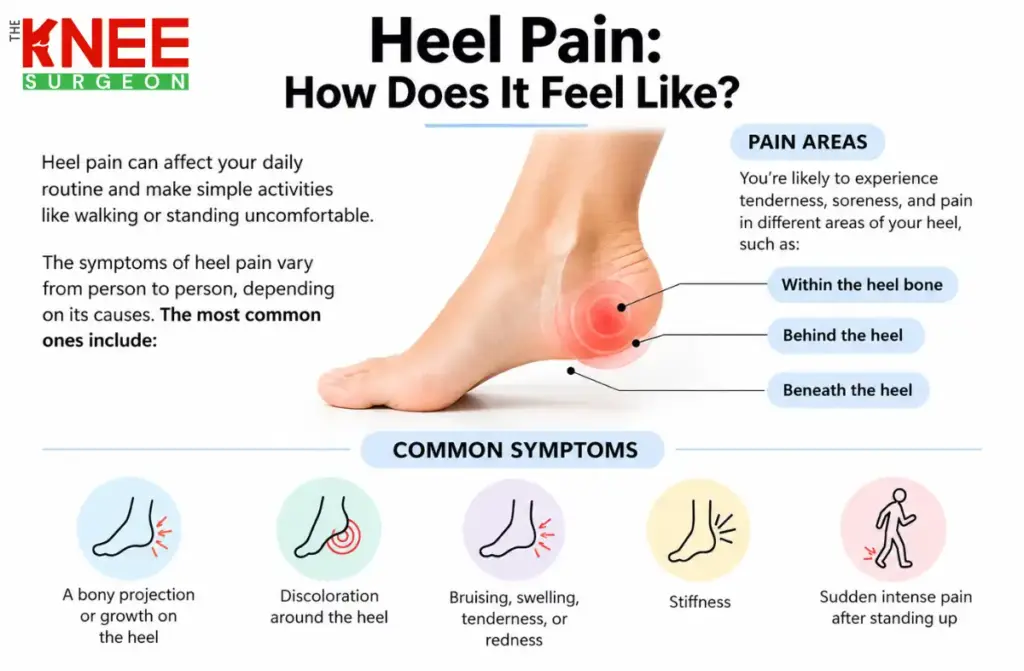
The location of the pain and when it occurs can provide useful clues. However, symptoms alone cannot always tell you exactly what is wrong.
| Pain pattern | What it may suggest |
| Pain under the heel, especially with the first steps after waking | Commonly associated with plantar heel pain or plantar fasciitis |
| Pain at the back of the heel | May be related to the Achilles tendon |
| Pain after increasing walking, running or exercise | May be associated with overuse or repetitive stress |
| Sudden pain following an injury | A fracture or tendon injury may need to be considered |
| Pain with significant swelling or tenderness | May occur with inflammation or another underlying problem |
This is why treating every heel pain in exactly the same way is not ideal. The treatment should be guided by what is causing the pain.
Why Does Heel Pain Become So Difficult to Ignore?
Every step places force through the foot and heel. Problems can develop when the tissues around the heel are repeatedly exposed to more stress than they can comfortably handle.
Common contributing factors include:
- A sudden increase in activity: Increasing walking, running or exercise too quickly can overload the tissues.
- Long periods on your feet: Prolonged standing can keep irritating an already painful heel.
- Hard surfaces: Frequent walking or standing on hard surfaces may aggravate symptoms.
- Unsupportive footwear: Shoes without adequate cushioning or support can increase discomfort.
- Tight calf muscles: Reduced flexibility can increase stress through the foot.
- Foot structure: High or low arches can change how forces are distributed.
- Increased body weight: Additional mechanical loading can place greater stress on the heel.
Finding these contributing factors matters because treatment should do more than temporarily reduce pain. It should also address what may be repeatedly irritating the heel.
When the First Steps in the Morning Hurt the Most
One of the most recognizable patterns of heel pain is discomfort with the first few steps after getting out of bed or after sitting for a while. This pattern is commonly associated with plantar fasciitis, which affects the strong band of tissue running along the bottom of the foot.
The pain may:
- Be felt underneath or around the heel.
- Be strongest when you first start walking.
- Ease somewhat as you move.
- Return after prolonged standing or walking.
But morning pain does not automatically confirm plantar fasciitis.
Several other conditions can produce similar symptoms. If the pain persists, keeps returning or interferes with normal activities, it is better to have the problem properly evaluated than to continue self-treating indefinitely.
The First Step in Treatment is Often Simpler Than You Think
Many common causes of heel pain can initially be managed without surgery.
The first goal is usually to reduce unnecessary stress on the painful tissues while maintaining appropriate movement.
Depending on the cause, treatment may include:
- Activity modification: Temporarily reduce running, jumping or other activities that clearly aggravate the heel.
- Supportive footwear: Comfortable shoes with appropriate cushioning and support can make walking easier.
- Reducing barefoot walking on hard floors: This may help when hard surfaces worsen symptoms.
- Gentle stretching: Calf and foot stretches may improve flexibility and reduce strain.
- Ice: Cold application can provide temporary symptom relief for some people.
- Heel pads or insoles: These may reduce pressure and improve comfort in selected cases.
The important point is that rest does not always mean complete inactivity. The aim is to reduce aggravating loads while allowing the foot to gradually recover.
Why “Just Rest It” Isn’t Always the Answer
When every step hurts, stopping all activity can seem like the obvious solution.
But there is another problem: avoiding movement completely for long periods is not necessarily helpful, while continuing the same activity despite worsening pain can keep irritating the heel.
A more practical approach is often activity modification:
- Reduce high-impact exercise temporarily.
- Take breaks during long periods of standing.
- Choose lower-impact activities when appropriate.
- Return to higher-impact activity gradually as symptoms improve.
The right amount of activity depends on the cause and severity of the heel pain. You may not need to stop moving—you may need to change how you are loading the heel.
When Simple Measures aren’t Enough
Some heel problems settle with appropriate footwear, activity changes and exercises. Others remain in pain despite these measures.
When symptoms continue, treatment may need to become more targeted. Depending on the diagnosis, an orthopedic treatment plan may include:
- Physiotherapy: To improve flexibility, strength, movement and loading patterns.
- Individualised exercises: The programme can be adapted to the specific condition.
- Orthotic support: Insoles may be considered when foot mechanics contribute to symptoms.
- Taping or night splints: These can be useful in selected cases.
- Medication: Appropriate pain relief may be recommended when necessary.
- Other interventions: Treatments such as shockwave therapy or injections may be considered for certain persistent conditions.
These treatments are not automatically suitable for everyone. More treatment does not necessarily mean better treatment. The diagnosis should determine the next step.
What If the Heel Still Hurts After Weeks of Treatment?
This is where many people make the mistake of simply repeating the same home remedy for months. Persistent heel pain deserves another look.
There are several possibilities:
- The original diagnosis may need to be reconsidered.
- The factors aggravating the heel may still be present.
- The condition may need a longer or more structured rehabilitation programme.
- A more targeted treatment may be appropriate.
This is particularly important because not every persistent heel pain is plantar fasciitis. If your symptoms are not improving as expected, an orthopedic evaluation can help determine whether the treatment needs to change.
Does Persistent Heel Pain Mean You Need Surgery?
Usually, no.
Many common heel pain conditions are initially treated without surgery. Even when symptoms persist, the next step is generally to reassess the diagnosis and consider appropriate non-surgical options before an operation is discussed.
Surgery may be considered only in selected cases where significant symptoms continue despite appropriate treatment and the underlying condition warrants it.
The treatment pathway should therefore be:
Accurate diagnosis → appropriate treatment → reassessment → targeted treatment when needed → surgery only for selected cases.
This approach helps avoid both unnecessary procedures and prolonged treatment of the wrong problem.
When Should You Stop Treating Heel Pain at Home?
Not every episode of heel pain requires immediate medical attention. However, certain symptoms should prompt professional evaluation.
Consider seeing a doctor if:
- The pain is severe or getting worse, particularly if walking is becoming difficult.
- Normal activities are being affected, including work, exercise or everyday movement.
- The pain is persistent despite appropriate home measures.
- Significant swelling or bruising develops, especially after an injury.
- You experience tingling or numbness, which may suggest a different cause.
- The pain began after an injury and has not settled.
- You cannot walk normally or comfortably bear weight.
Persistent pain is not something you simply have to accept as part of daily life.
Treatment Should Help You Move Better—Not Just Hurt Less
It is easy to judge treatment by one question:
“Has the pain stopped?”
But successful heel pain treatment should go further.
| Treatment goal | What it means |
| Control pain | Make walking and everyday activities more comfortable. |
| Reduce excessive loading | Modify activities and footwear that aggravate symptoms. |
| Improve flexibility | Address calf and foot tightness when relevant. |
| Restore strength and movement | Rebuild normal foot and lower-limb function. |
| Prevent recurrence | Identify and address factors that contributed to the problem. |
The aim is not simply to cover up the symptoms. It is to help the heel recover and allow you to return to comfortable movement.
Don’t Let Heel Pain Become Your New Normal
Heel pain can slowly change the way you walk, exercise and manage everyday activities. The longer you compensate for it, the more disruptive it can become. But treatment does not have to mean immediately moving toward injections or surgery.
For many people, the right combination of activity modification, supportive footwear, stretching, rehabilitation and targeted treatment can make a significant difference. The important part is matching the treatment to the underlying problem.
At MAHI Hospitals, heel pain is approached by first understanding the patient’s symptoms and condition and then selecting treatment accordingly. Dr. Vijay Kumar Sohanlal is successfully providing treatment for patients with heel pain, helping them work toward better comfort, movement and return to their routine.
If heel pain is persistent, worsening or interfering with your everyday activities, an orthopedic evaluation can help determine the appropriate next step.
Read More: Indian Food for Strong Bones.