
Medically Reviewed by: Dr. Vijay Kumar Sohanlal, MBBS, MS (Orthopaedics), Orthopaedic & Joint Replacement Surgeon, Founder & Owner, MAHI Multispeciality Hospitals, Kilpauk, Chennai.
Last medically reviewed: August 2026
If knee pain has started dictating your day. Which stairs you avoid, how far you’re willing to walk, whether you sit on the floor at a family function, you’ve probably already searched “best knee replacement surgeon in India” more than once. It’s a strange kind of search. Unlike buying a phone or a flight, you can’t compare knee surgeons on a spec sheet. You’re trying to judge someone’s hands, judgment, and honesty from a website, and that’s genuinely hard to do.
This guide walks through how surgeons are actually evaluated in orthopedics, in the kind of detail a patient sitting across the desk would ask for, not a rewritten summary of what other sites already say. It also covers where Dr. Vijay Kumar Sohanlal fits into that picture for patients in Chennai and across South India.
Why Knee Replacement Has Become So Common in India
Knee osteoarthritis is the single biggest reason people end up needing this surgery. It’s a slow process. Cartilage that once cushioned the joint wears thin, bone starts rubbing on bone, and what began as occasional stiffness turns into pain that doesn’t go away with rest. Rheumatoid arthritis, old ligament injuries that were never fully treated, and post-traumatic damage from fractures add to the numbers.
India’s patient pool skews younger than in Western countries. It’s common to see people in their late 40s and early 50s already considering surgery, often from a combination of genetics, weight, and knees that have carried decades of squatting, floor-sitting, and stair-climbing, movement patterns that Western hip and knee joints are rarely put through to the same degree. That’s one reason the “best surgeon” question in India isn’t purely about age-related wear. It’s often about restoring an active, working-age life, not just managing old age.
What “Best” Actually Means in Orthopedic Surgery
There’s no official ranking body that certifies someone as “the best knee replacement surgeon in India.” When a claim like that is used credibly, it should be backed by things a patient can verify, not just stated. Here’s what actually separates a strong surgeon from an average one, based on what orthopedic outcomes literature and clinical practice consistently point to:
- Surgical volume in this specific procedure. A surgeon who does knee and hip replacements every week, year after year, develops a different level of instinct than one who does a handful annually alongside general orthopedic work. Ask directly how many total knee replacements the surgeon performs in a typical year, and how many of those were revision cases.
- Training that goes beyond the basic MS Orthopaedics degree. An MBBS and MS (Orthopaedics) is the baseline qualification to practice orthopedic surgery in India. What distinguishes a joint-replacement specialist is additional fellowship training specifically in arthroplasty, ideally including time spent in centers abroad where robotic and navigation-guided techniques were developed and refined years before they reached most Indian hospitals.
- Comfort with more than one surgical approach. Not every knee needs a robotic total replacement. Some patients are better candidates for a partial (unicompartmental) replacement; some need a more conservative approach first. A surgeon who only offers one technique isn’t necessarily matching the solution to the knee. They may instead be matching the knee to their preferred tool.
- Transparency about outcomes and complications. No honest surgeon will tell a patient knee replacement has zero risk. Infection, blood clots, implant loosening, and stiffness are all real, if uncommon, possibilities. A surgeon who explains these risks plainly, rather than glossing over them, is usually the one being straight about everything else too.
- A rehabilitation plan, not just a surgery date. The operation itself is maybe a third of the outcome. Structured physiotherapy in the days and weeks after surgery is what actually determines whether a patient gets full range of motion back. If a surgeon’s team can’t describe their physiotherapy protocol step by step, that’s worth noticing.
Types of Knee Replacement Surgeries
Total Knee Replacement
Total knee replacement involves replacing the damaged surfaces of the entire knee joint with artificial components. It is commonly recommended for people with advanced arthritis, severe cartilage loss, or extensive joint damage causing persistent pain and difficulty with movement. The goal is to relieve pain, restore knee function, and help patients return to everyday activities.
Partial Knee Replacement
Partial knee replacement is considered when damage is limited to a specific compartment of the knee while the rest of the joint is relatively healthy. Instead of replacing the entire knee, the surgeon replaces only the affected portion and preserves healthy bone, cartilage, and surrounding tissue. For suitable patients, this can mean a quicker recovery and a more natural-feeling knee.
Robotic-Assisted Knee Replacement
Robotic-assisted knee replacement uses computer-guided technology to support the surgeon during preoperative planning and implant positioning. The system helps assess the knee and plan bone cuts and implant alignment based on the patient’s individual anatomy, captured through pre-op imaging. The technology can improve precision, but the procedure is still performed and controlled by the surgeon’s hands throughout. Suitability depends on the patient’s condition, anatomy, and the surgeon’s clinical assessment, not just patient preference.
Robotic-Assisted vs. Traditional Knee Replacement
Robotic-assisted surgery has become a genuine talking point in Indian orthopedics over the last several years, and for good reason. It lets the surgeon build a 3D surgical plan specific to the patient’s knee anatomy before a single cut is made, then execute that plan with more consistency than freehand instrumentation allows. In practice, this tends to translate into more accurate implant alignment and, for many patients, a smoother early recovery.
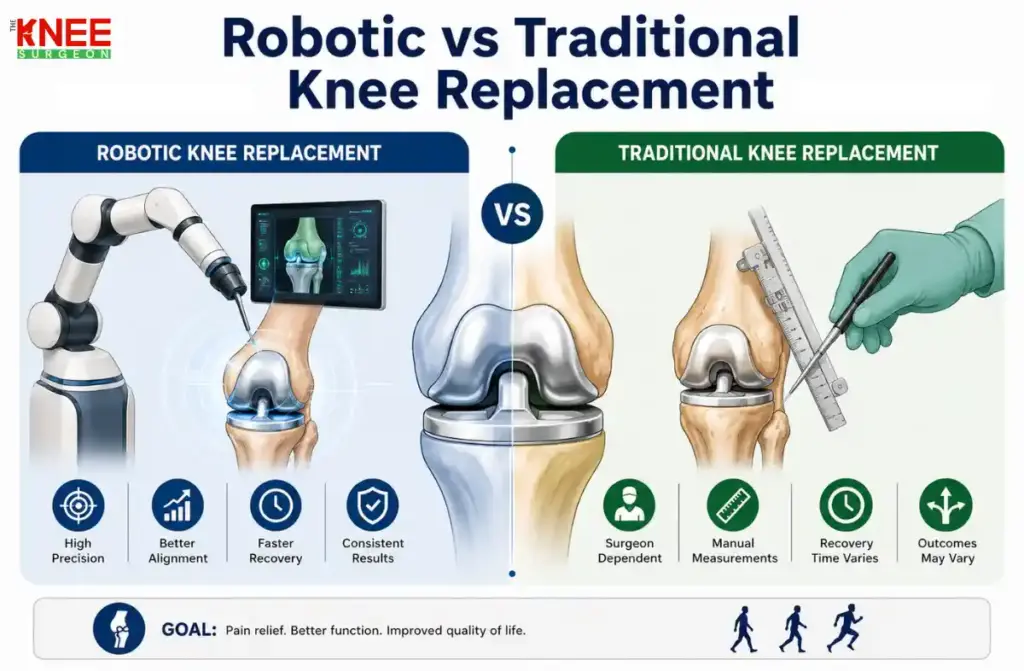
That said, robotic assistance is a tool in a skilled surgeon’s hand, not a replacement for skill. A less experienced surgeon using a robotic system won’t automatically outperform a highly experienced surgeon using conventional instrumentation. The technology narrows the margin for error; it doesn’t eliminate the need for surgical judgment on things like soft-tissue balancing, which still comes down to hands-on experience built over hundreds of procedures.
If cost is a factor, and for most Indian patients it is, it’s worth knowing that robotic-assisted procedures typically carry a modest premium over conventional surgery, mainly from equipment and disposable costs. It’s reasonable to ask a surgeon plainly whether robotic assistance is genuinely indicated for a specific case, or whether a well-executed conventional procedure would serve just as well.
About Dr. Vijay Kumar Sohanlal
Dr. Vijay Kumar Sohanlal is an orthopedic and joint replacement surgeon based in Chennai, with over 18+ years of clinical experience in knee and hip surgery. His training includes time in Mumbai as well as international fellowship exposure in Germany and Australia, where navigation-guided and robotic-assisted joint replacement techniques were in routine clinical use well before they became common in India.
He practices both robotic-assisted and conventional knee replacement, which matters because the choice of technique is made based on the patient’s anatomy and condition rather than being the only option on offer. His practice is built around minimally invasive approaches where appropriate, with the aim of reducing tissue trauma and shortening the walk-to-recovery timeline.

- Experience: 18+ years
- Qualifications: MBBS, MS (Orthopaedics)
- Specialties: Robotic knee replacement, hip replacement, complex joint surgeries
- Founder and Owner of MAHI Hospitals, Chennai
- Practice Locations: MGM Healthcare ,Chennai 600030
Dr. Vijay Kumar Sohanlal consults and operates through MAHI Multispecialty Hospital in Kilpauk and MGM Healthcare in Aminjikarai, Chennai. Patients researching him independently can cross-check reviews directly on Google, Practo, and Justdial rather than relying solely on testimonials published on his own site, which is generally sound practice with any surgeon under consideration, not just this one.
Symptoms That May Indicate You Need Knee Replacement Surgery
Knee pain does not automatically mean surgery is needed. But when pain, stiffness, and reduced mobility continue despite non-surgical treatment and start interfering with everyday life, a knee replacement may be worth discussing after an orthopaedic evaluation.
- Severe knee pain while walking. Persistent pain while walking, standing, or performing routine movements can signal advanced joint damage. When it becomes frequent and starts limiting normal activity, a specialist evaluation helps identify the underlying cause.
- Difficulty climbing stairs. Pain, weakness, or instability while climbing or descending stairs often shows up when cartilage damage is significant. If it persists and starts affecting daily independence, it’s worth having assessed.
- Knee stiffness and reduced mobility. Advanced arthritis can make it difficult to fully bend or straighten the knee. Reduced range of motion tends to show up first in small things: getting up from a low chair, sitting cross-legged, or managing a squat toilet.
- Persistent swelling and inflammation. Ongoing swelling or tenderness can indicate active joint inflammation from arthritis or another underlying condition, and should be assessed rather than managed indefinitely with over-the-counter medication.
- Knee pain affecting sleep. When pain continues at rest or wakes a patient at night, it’s usually a sign that conservative treatment has stopped being enough, and a surgical opinion is worth getting.
Conditions Treated by Knee Replacement Surgeons
- Osteoarthritis of the knee, the most common reason for knee replacement, caused by progressive cartilage loss leading to pain, stiffness, and reduced movement.
- Rheumatoid arthritis, an inflammatory condition that can damage joint structures over time, in advanced cases causing persistent pain, deformity, and loss of function.
- Post-traumatic arthritis, which can develop years after a fracture or ligament injury as joint damage accumulates.
- Knee damage from sports injuries, where repeated or significant trauma contributes to cartilage damage and progressive instability.
- Advanced cartilage and joint degeneration, where reduced cushioning between the bones leads to increasing pain and restricted movement over time.
Benefits of Knee Replacement Surgery
For appropriately selected patients, knee replacement can meaningfully reduce pain and restore function, though outcomes vary with overall health, the condition of the knee going in, and how consistently rehabilitation is followed.
- Relief from chronic pain: replacing severely damaged joint surfaces significantly reduces arthritis-related pain for most patients who complete recovery.
- Improved walking and mobility: with reduced pain and proper rehab, walking, standing, and using stairs generally become easier.
- Better joint stability: correctly positioned implants restore alignment, supporting more stable, comfortable movement.
- Improved quality of life: many patients report better sleep, more confidence, and greater independence after recovery.
- Return to everyday activities: most patients gradually resume routine activity, with pace and exercise type guided by their surgeon and physiotherapy team.
Questions Worth Asking at Your First Consultation
A first orthopedic consultation can feel rushed, especially at busy hospitals. Going in with a short, specific list of questions tends to get more useful answers than a general “what do you think, doctor”:
- How many total and partial knee replacements have you personally performed, and how many do you do in a typical month?
- For my specific knee, would you recommend robotic-assisted or conventional surgery, and why?
- What’s your personal infection rate, and what protocols reduce that risk?
- What does the first two weeks of physiotherapy actually look like, day by day?
- If something doesn’t go as planned, what’s the revision plan?
- Can I speak with a previous patient who had a similar condition to mine?
A surgeon who answers these directly and specifically, rather than with reassurance and vague numbers, is generally one worth trusting further.
Recovery: What Actually Happens After Surgery
Recovery timelines vary by patient, but there’s a fairly consistent general pattern worth knowing before going in:
Days 1 to 3: Most patients are helped to stand and take a few assisted steps within 24 hours of surgery. This early mobilization is now standard practice and genuinely helps reduce complications like blood clots.
Weeks 1 to 6: The physiotherapy-heavy stretch. Pain and swelling gradually reduce, and most patients progress from a walker to a stick to walking unaided, though the pace varies a lot person to person based on age, pre-surgery muscle strength, and how consistently physiotherapy is followed.
Months 2 to 3: Most patients resume normal daily activities such as driving, light household work, and walking for exercise. Muscle strength and confidence typically continue improving through this period.
Months 3 to 6 and beyond: This is where the long-term outcome really settles in. Continued strengthening, a healthy body weight, and avoiding high-impact activity (deep squatting, running, jumping sports) all support implant longevity.
Modern knee implants are generally expected to last 15 to 20 years or more with good care, though this varies with implant type, activity level, and body weight.
What Knee Replacement Costs in India, and Why It Varies
Cost is one of the few areas where India genuinely stands out globally. The same standard of surgery that costs several times more in the US, UK, or parts of the Middle East is available here at a fraction of the price, without a meaningful drop in surgical quality at reputable centers.
Within India, cost still varies based on a few concrete factors:
- Implant brand and type: imported premium implants cost more than domestically manufactured ones, though both meet safety standards.
- Robotic vs. conventional technique: robotic assistance adds to the bill due to equipment costs.
- Hospital category and room type: a private single room versus a shared ward changes the overall package meaningfully.
- Unilateral vs. bilateral surgery: whether one or both knees are being replaced, and whether that’s done in a single sitting or staged.
- Insurance coverage: many Indian health insurance policies do cover knee replacement, but it’s worth confirming pre-authorization requirements and any waiting-period clauses before committing to a date.
Rather than comparing a single headline number between hospitals, ask for an itemized estimate separating surgeon fees, implant cost, hospital stay, and physiotherapy. It makes real comparison possible.
Making the Final Decision
There’s rarely a single “correct” answer to who the best knee replacement surgeon in India is for a given patient. It depends on the city, the specific knee condition, budget, and, honestly, how comfortable a patient feels with the surgeon as a person, since this involves trusting someone with a major decision about their body. What’s controllable is the homework: checking real credentials, asking pointed questions, verifying reviews independently, and understanding what recovery will actually demand.
Patients in Chennai or South India wanting to discuss a specific case can book a consultation with Dr. Vijay Kumar Sohanlal through MAHI Multispecialty Hospitals or MGM Healthcare for a personalized assessment of the knee and the options available.
As a top orthopedic surgeon in India, he is known for combining clinical excellence with compassionate care, making him a preferred choice for knee replacement procedures.
Read more: Best Medicine for Knee Pain in Old Age.